Go to the previous post to see the line up of authors and quotes.
Saturday, March 12, 2016


Tuesday, March 8, 2016
Some (sort of anonymous) thoughts on theology
The following list of various approaches to, and understandings of, theology includes some that I've been canvassing with my students in my introductory unit, Faith, Theology and Doctrines. I've added some others as well. The authors are unidentified for now. Some of the approaches are dead give-aways, and in this age of all-powerful search engines, the sources of most of these quotes could be tracked down pretty easily. But for those who would like to think about who might be the authors, I'll wait a few days before adding their names. Inclusion in this list does not necessarily constitute endorsement on my part!
If necessary...one must start from a new perspective if this is the best way to recapture the contemporary imagination for Christ, or to reinvite reflection on the perennial mysteries of the gospel. Such is the inspiration of the notion of systematics that informs this work. Systematics, in other words, does not convey the hubristic ideas of a totalizing discourse that excludes debate, opposition, or riposte; but on the other hand, it does not falter at the necessary challenge of representing the gospel afresh in all its ramifications - systematically unfolding the connections of the parts of the vision that is set before us.
Theology means struggle.
The function of theology as critical reflection on praxis has gradually become more clearly defined in recent years, but it has its roots in the first centuries of the Church's life. The Augustinian theology of history which we find in The City of God, for example, is based on a true analysis of the signs of the times and the demands with which they challenge the Christian community.
But can there be any Logos, any systematic and rational clarification, of God? If theology were simply a 'theory about God', analogous to ossology (the theory of bones), then it would be an insult to God, blasphemy. The object of theology can only be the relationship between God and human beings: in other words, reflection on the experiences that have compelled human beings to talk about something like 'God'.
[T]heology is actual as a continuing consultation. Theology is not the adding of proposition to proposition in the steady construction of a planned structure of knowledge. It is a discussion and debate that as it continues regularly confronts new questions, and from which participants drop out and into which new participants enter.... It is the fate of every theological system to be dismembered and have its fragments bandied about in an ongoing debate.
The riches of the imagination can aid the task of discipleship, but in order to do so, the imagination itself must be trained by doctrine to nourish hope, encourage perseverance in faith and demonstrate the love in which Christians participate as members of Christ. Doctrine is a gift of the rationally capacious to structure our imaginations according to Christian hope.
Dogmatics as systematic theology proceeds by way of both assertion and hypothesis as it offers a model of the world, humanity, and history as they are grounded in God, a model which, if it is tenable, will 'prove' the reality of God and the truth of Christian doctrine, showing them to be consistently conceivable and also confirming them, by the form of presentation. In this way dogmatics expounds the truth claim of Christian teaching. it shows how this teaching must be understood in context if it is to be accepted as truth.
****
UPDATE:
At the request of one of my readers here's a list (in alphabetical order) of the authors of the following quotes. I'll link the authors to the actual quotes in a day or so.
Karl Barth - Sarah Coakley- Gustavo Gutiérrez - Robert Jenson - Elizabeth Johnson - James McClendon - Wolfhart Pannenberg - Dorothee Sölle - C.S. Song -
Medi-Ann Volpe
****
UPDATE 2:
So, all is now revealed.
****
UPDATE 2:
So, all is now revealed.
****
 |
| Sarah Coakley |
 |
| James McClendon |
Theology means struggle.
Thus the real results of dogmatics, even though they have the form of the most positive statements, can themselves only be new questions, questions to and fro between what the Church seems to proclaim and the Bible seems to want proclaimed, questions which can be put only with the greatest modesty and a sense of supreme vulnerability if they are perhaps serious and significant questions.
Karl Barth
 |
| Gustavo Gutiérrez |
 |
| Dorothee Soelle |
But can there be any Logos, any systematic and rational clarification, of God? If theology were simply a 'theory about God', analogous to ossology (the theory of bones), then it would be an insult to God, blasphemy. The object of theology can only be the relationship between God and human beings: in other words, reflection on the experiences that have compelled human beings to talk about something like 'God'.
 |
| Robert Jenson |
 |
| Elizabeth Johnson |
Rooted in the Christian tradition and equipped with scholarly tools, those of us in the theological guild think about the meaning of faith and the way it is practiced. The purpose is to shed more light on the gospel, so it can be lived out with deeper understanding and vibrant love of God and neighbour.
 |
| Medi Ann Volpe |
The riches of the imagination can aid the task of discipleship, but in order to do so, the imagination itself must be trained by doctrine to nourish hope, encourage perseverance in faith and demonstrate the love in which Christians participate as members of Christ. Doctrine is a gift of the rationally capacious to structure our imaginations according to Christian hope.
 |
| C.S.Song |
For most Christian faith traditions and schools of Christian theology, the question of God is the beginning point. And yet, when we think of the whole more deeply, we may realize that this time-honoured way of doing theology parts company with the methods of science and technology. Science seeks to discover what is presently unknown by the study of what is known. God is a great unknown. To begin with God, therefore, is to attempt to explain what is known by what is not known, quite the opposite of how science proceeds. Rather we should begin where we are with what can be known through our experience in the world and see where it take us.
 |
| Wolfhart Pannenberg |
Dogmatics as systematic theology proceeds by way of both assertion and hypothesis as it offers a model of the world, humanity, and history as they are grounded in God, a model which, if it is tenable, will 'prove' the reality of God and the truth of Christian doctrine, showing them to be consistently conceivable and also confirming them, by the form of presentation. In this way dogmatics expounds the truth claim of Christian teaching. it shows how this teaching must be understood in context if it is to be accepted as truth.
Tuesday, March 1, 2016
Books Worth Reading (5): Christianity: A Very Short Introduction by Linda Woodhead
Linda Woodhead, Christianity: A Very Short Introduction 2nd ed (Oxford: Oxford University Press, 2014).
 This book is neither a work of apologetics directed to non-Christians nor an exposition of the Christian faith written for
insiders. It is a social, historical and cultural description of Christianity written
for readers who are theologically uncommitted and culturally- and/or intellectually curious. But it is, nevertheless, a book that the theologically-committed insider could find well-worth reading, precisely because it gives something of an outsider's perspective on this phenomenon we know as 'Christianity'.
This book is neither a work of apologetics directed to non-Christians nor an exposition of the Christian faith written for
insiders. It is a social, historical and cultural description of Christianity written
for readers who are theologically uncommitted and culturally- and/or intellectually curious. But it is, nevertheless, a book that the theologically-committed insider could find well-worth reading, precisely because it gives something of an outsider's perspective on this phenomenon we know as 'Christianity'.
Woodhead is Professor of Sociology of Religion in the Department of Politics, Philosophy and Religion at Lancaster University. She is one of the most prominent and prolific sociologists writing on religion, especially on religion in the UK. As a sociologist she has particular ideological commitments shaped by that discipline, but that in no way devalues the book or lessens its value to a Christian reader. It is impossible to tell from this work her own relationship to the Christian faith (and this is a strength and not a weakness of the book).

It is of course, the person of Jesus and some basic beliefs about him which constitute the core of this 'repertoire'. She makes the fairly obvious point that the "canonical Jesus is far more influential than any 'real' Jesus who lies behind the gospels and inspires their portraits" (p.7). Because she is not writing for the theologically-committed, she can make this historical and cultural observation without having to enter contemporary theological debates about the relationship between Jesus and the gospels: "So far as history is concerned, it is the Jesus of the New Testament who has inspired more lives and worked more miracles than the elusive figure historians struggle to reconstruct" (p.7). The theologically committed will take comfort or discomfort from this depending on their views of the status of the 'biblical' or 'canonical' Jesus, but the theologically-neutral observation about the historically-influential Jesus, needs to be weighed in any attempt to find a more 'real' Jesus allegedly more germane to contemporary or culturally-specific interests.
 As she surveys the contemporary global phenomenon of Christianity, she does seem to suggest that there is one particularly decisive fault line which runs through and across all the different types of Christianity: "More than modern science, it is modern liberal values and a turn to subjective experience which have challenged and divided Christians" (p. 90). She also suggests that Liberal Christianity will have to come to terms with its own failed promise. At it origins, Liberal Christianity saw itself as part of the onward march of modern history which would sweep aside tyranny and "superstition, and replace them with more liberal political arrangements and more rational faith" (p. 97f). 'History', however, has pursued different paths and Liberal Christianity is largely being bypassed: "Right up to the 1970s it seemed reasonable to think that Liberal Christianity would continue to dominate the Christian, especially Protestant world.... Despite the considerable success...by the end of the 20th century it was clear that confidence in its inevitable triumph had been misplaced" (p.98f). (This observation certainly warrants reflection within the UCA and other mainline protestant churches which have been deeply shaped by the traditions of liberal theology, but that's a task beyond this present post.)
As I noted above, although the book is written for the theologically uncommitted, I think that the theologically committed would find it well worth reading precisely to get a taste of how Christianity is presented when there is no grinding of the theological axes which (inevitably and often quite properly) preoccupy the churches. In that way the book could be a helpful change of pace for church discussion groups which might otherwise draw on typically internal resources to spark their discussions. In short: this book could serve such groups very well and help them get even just a hint of what Christianity looks like from the outside - across both time and place. I can't help but think that that would be a good thing.
(This series of 'books worth reading' engages an eclectic selection of books: some directly related to my teaching, some to the UCA, and some of more general theological interest. They are not offered as technical book reviews, but as summaries which highlight why I think they might be useful resources, good conversation starters, or volumes that make helpful contributions to scholarly debate.)
 This book is neither a work of apologetics directed to non-Christians nor an exposition of the Christian faith written for
insiders. It is a social, historical and cultural description of Christianity written
for readers who are theologically uncommitted and culturally- and/or intellectually curious. But it is, nevertheless, a book that the theologically-committed insider could find well-worth reading, precisely because it gives something of an outsider's perspective on this phenomenon we know as 'Christianity'.
This book is neither a work of apologetics directed to non-Christians nor an exposition of the Christian faith written for
insiders. It is a social, historical and cultural description of Christianity written
for readers who are theologically uncommitted and culturally- and/or intellectually curious. But it is, nevertheless, a book that the theologically-committed insider could find well-worth reading, precisely because it gives something of an outsider's perspective on this phenomenon we know as 'Christianity'.Woodhead is Professor of Sociology of Religion in the Department of Politics, Philosophy and Religion at Lancaster University. She is one of the most prominent and prolific sociologists writing on religion, especially on religion in the UK. As a sociologist she has particular ideological commitments shaped by that discipline, but that in no way devalues the book or lessens its value to a Christian reader. It is impossible to tell from this work her own relationship to the Christian faith (and this is a strength and not a weakness of the book).
Belonging to this particular OUP series, it is, obviously enough, a very short book: only 120 pages. It is divided into 6 chapters: (1) Jesus: the God-man; (2) Beliefs, rituals and narratives; (3) The spread of Christianity; (4) Church and Biblical Christianity; (5) Monastic and mystical Christianity; and (6) Christianity in the modern world. Then follows a Conclusion, a two-page chronology of the major events in Christianity's history, and the customary Suggestions for Further Reading.
She describes the first two chapters as introducing "the basic Christian repertoire" (1). It's an interesting phrase which offers a rather different framework than might, say, 'doctrines' or 'beliefs'. Indeed, she uses it to identify what it is typical of Christianity across it doctrinal diversity. She refers to how "we can turn down the volume on such differences in order to introduce common themes in the Christian repertoire" (p.21).

It is of course, the person of Jesus and some basic beliefs about him which constitute the core of this 'repertoire'. She makes the fairly obvious point that the "canonical Jesus is far more influential than any 'real' Jesus who lies behind the gospels and inspires their portraits" (p.7). Because she is not writing for the theologically-committed, she can make this historical and cultural observation without having to enter contemporary theological debates about the relationship between Jesus and the gospels: "So far as history is concerned, it is the Jesus of the New Testament who has inspired more lives and worked more miracles than the elusive figure historians struggle to reconstruct" (p.7). The theologically committed will take comfort or discomfort from this depending on their views of the status of the 'biblical' or 'canonical' Jesus, but the theologically-neutral observation about the historically-influential Jesus, needs to be weighed in any attempt to find a more 'real' Jesus allegedly more germane to contemporary or culturally-specific interests.
Woodhead's sociological framework is perhaps most evident in her alertness to the connections between social conditions and the spread of Christianity over its 2000-year history. In this regard her brief overview is a helpful foil to the often romanticised and triumphant accounts of Christianity's expansion. For instance, she notes the pre-700AD limited eastward-spread of Christianity towards India and China and their existing religions. She then contrasts this with the more successful westward spread during the same period. Of this contrast she notes: "Without political backing Christianity was unable to do more than win over small marginal social groups when other religions dominated a territory". On the other hand, the alliance between Christianity and power which accompanied Christianity's renewed attempts to move into those areas in the area of European colonisation did not necessarily lead to greater acceptance. If anything, it has been the "withdrawal of Western colonial powers [that] has led to greater opportunities for Christianity than before" (p. 54). In an important passage, she notes the alliance between certain forms of Christianity, globalisation, and the twentieth-century expansion of Christianity into the global south. Here she finds parallels with the spread of Islam in the same areas during the same period. Her comments are worth quoting at some length.
In this post-colonial phase, Christianity has been more fully owned and adopted by people who were previously colonial subjects. Many parts of the southern hemisphere have witnessed the growth of new globally networked forms of Christianity, most notably the Pentecostal and Charismatic.... Since their rise has been contemporaneous with that of resurgent Islam, it is interesting to compare the two. Both have flourished in territories which were previously under western colonial control. Both have a globalizing tendency. Both represent indigenous movements of modernization. To be part of recent Islamic or Charismatic upsurges is to be part of global movements with the resources and sense of universal, triumphant purpose that entails. Individuals' horizons and sense of identity are raised from the local or even the national to the global level by belonging to these religions, and power is enhanced accordingly. Through membership one can lay hold of many of the benefits of modernity - including education, technology, and affluence - but without having to westernize. The best of both worlds (p. 54).
There are all sorts of interesting sparks to reflection here, not least the connection between faith, power, globalization and modernity. And the relation of this phenomenon to the attraction of earlier power-less forms of Christianity to 'small marginal groups' warrants considerable theological reflection.
The expansion of Christianity during the previous century has, of course, taken many forms. Yet, for Woodhead,"[u]nderstanding this huge internal variety within Christianity is less important than understanding the religion's main fault lines" (p.57). To this end (and with a sociologist's nod to Ernst Troeltsch) she believes the diversity of Christianity can best be described in terms of what she designates as its four major types: church, biblical, mystical and monastic. Her descriptions of each of these types are highly illuminating. Perhaps just as illuminating is her suggestion that despite the recent expansion and diversification, none of the new manifestations of Christianity in Asia or Africa, for instance, has introduced any new basic type. Pentecostalism, Fundamentalism, and Charismatic Evangelicalism can still be classified by new four-fold typology, even if in different configurations (see p. 89). In other words, the expansion of Christianity in Asia and Africa is proceeding along trajectories which are generated by the basic reality that Christianity is and has been.
 As she surveys the contemporary global phenomenon of Christianity, she does seem to suggest that there is one particularly decisive fault line which runs through and across all the different types of Christianity: "More than modern science, it is modern liberal values and a turn to subjective experience which have challenged and divided Christians" (p. 90). She also suggests that Liberal Christianity will have to come to terms with its own failed promise. At it origins, Liberal Christianity saw itself as part of the onward march of modern history which would sweep aside tyranny and "superstition, and replace them with more liberal political arrangements and more rational faith" (p. 97f). 'History', however, has pursued different paths and Liberal Christianity is largely being bypassed: "Right up to the 1970s it seemed reasonable to think that Liberal Christianity would continue to dominate the Christian, especially Protestant world.... Despite the considerable success...by the end of the 20th century it was clear that confidence in its inevitable triumph had been misplaced" (p.98f). (This observation certainly warrants reflection within the UCA and other mainline protestant churches which have been deeply shaped by the traditions of liberal theology, but that's a task beyond this present post.)
As I noted above, although the book is written for the theologically uncommitted, I think that the theologically committed would find it well worth reading precisely to get a taste of how Christianity is presented when there is no grinding of the theological axes which (inevitably and often quite properly) preoccupy the churches. In that way the book could be a helpful change of pace for church discussion groups which might otherwise draw on typically internal resources to spark their discussions. In short: this book could serve such groups very well and help them get even just a hint of what Christianity looks like from the outside - across both time and place. I can't help but think that that would be a good thing.
(This series of 'books worth reading' engages an eclectic selection of books: some directly related to my teaching, some to the UCA, and some of more general theological interest. They are not offered as technical book reviews, but as summaries which highlight why I think they might be useful resources, good conversation starters, or volumes that make helpful contributions to scholarly debate.)
Tuesday, February 23, 2016
How not to waste a theological education
It's Week 1 of Semester 1 for the 2016 academic year at Pilgrim Theological College, the college where I teach. For many it's the very start of their theological education. It happens also to be thirty years this year since I had my own Week 1, Semester 1 of theological study and ministerial formation. Half of those thirty years have been as a theological student or congregational minister. The other half has been as a theological teacher.
One of the things common across these three decades is that people still come to theological education with various warnings from their friends and family echoing in their ears. Thirty years ago, it was most likely, 'don't let them destroy your faith'. There is still some of that (and I'm now one of the 'them'!). But the more likely warning today is 'they won't equip you for the changed context'.
The interesting thing about the anxiety in the 1980s was the assumption that ministerial formation was about theological education; the anxiety was about getting the 'right' kind of theology. The assumption of the 2010s is that ministerial formation is more than theological education; the anxiety is about making sure there's a proper alignment of theology to contextual awareness.
Most of the recent debates about ministerial formation in the UCA have been driven by the anxiety of the 2010s - and rightly so. (Although, I do feel constrained to say that even in the ministerial formation I received in the 1980s, I was never encouraged to think that theological education was by itself a sufficient preparation for ministry. There may have been deficiencies in how that distinction was addressed, but - even as one who was especially drawn to theological study - I was never under any illusion that competence as a theological student was immediately transferable to competence in ministry.) Addressing the anxiety also requires attention to the role of theological wisdom in ministerial formation. We'll only know how to align the two properly if we have a clear sense of what the purpose of theological study is in the first place. Otherwise, the debate will simply be a political tussle between different ecclesiastical stakeholders.
I came at this question, albeit a bit tangentially, in a sermon I preached in our college chapel last year when I addressed the awful possibility of candidates for ministry wasting the time they spent in theological education.
A discussion of what it means to provide theological leadership could well occupy a month of blog posts, but for now I'll make this single point: to provide theological leadership is to help the congregation or some other community of faith to enter into the shock, strangeness and novelty of the Christian gospel. It's about pointing back to the seminal events of Jesus' life, death and resurrection and drawing from them an orientation to the present and the future. It is this which not only orients us to the church's only foundation, it is also the point from which we gain critical leverage over any cultural or ecclesial domestication of the church (the risk of which is not an iota lessened by orientation to the changed context). At least one dimension of the purpose of theological education as one part of a wider process of ministry formation is, therefore, to have one's imagination intentionally drawn into, and cultivated by, this shock and strangeness, or what Rowan Williams calls, the 'realignment' of talk about God provoked by Jesus and what happened to him. So, in Williams' own words:
One of the things common across these three decades is that people still come to theological education with various warnings from their friends and family echoing in their ears. Thirty years ago, it was most likely, 'don't let them destroy your faith'. There is still some of that (and I'm now one of the 'them'!). But the more likely warning today is 'they won't equip you for the changed context'.
The interesting thing about the anxiety in the 1980s was the assumption that ministerial formation was about theological education; the anxiety was about getting the 'right' kind of theology. The assumption of the 2010s is that ministerial formation is more than theological education; the anxiety is about making sure there's a proper alignment of theology to contextual awareness.
Most of the recent debates about ministerial formation in the UCA have been driven by the anxiety of the 2010s - and rightly so. (Although, I do feel constrained to say that even in the ministerial formation I received in the 1980s, I was never encouraged to think that theological education was by itself a sufficient preparation for ministry. There may have been deficiencies in how that distinction was addressed, but - even as one who was especially drawn to theological study - I was never under any illusion that competence as a theological student was immediately transferable to competence in ministry.) Addressing the anxiety also requires attention to the role of theological wisdom in ministerial formation. We'll only know how to align the two properly if we have a clear sense of what the purpose of theological study is in the first place. Otherwise, the debate will simply be a political tussle between different ecclesiastical stakeholders.
I came at this question, albeit a bit tangentially, in a sermon I preached in our college chapel last year when I addressed the awful possibility of candidates for ministry wasting the time they spent in theological education.
 |
| The mainline Protestant theological shuffle |
It is not the purpose of a theological education to shuffle you along some conservative-liberal spectrum. What a shocking waste of three or four years of your life that would be if that's all that happened in your theological education.
Nor is it the purpose of a theological education to make you virtuosos of the diversity of the theological world. If all you leave college with is an appreciation of theological diversity, then you may well be able to theologically manage your congregations, but you will never lead them theologically. And what a failure of theological education that too would be.
A discussion of what it means to provide theological leadership could well occupy a month of blog posts, but for now I'll make this single point: to provide theological leadership is to help the congregation or some other community of faith to enter into the shock, strangeness and novelty of the Christian gospel. It's about pointing back to the seminal events of Jesus' life, death and resurrection and drawing from them an orientation to the present and the future. It is this which not only orients us to the church's only foundation, it is also the point from which we gain critical leverage over any cultural or ecclesial domestication of the church (the risk of which is not an iota lessened by orientation to the changed context). At least one dimension of the purpose of theological education as one part of a wider process of ministry formation is, therefore, to have one's imagination intentionally drawn into, and cultivated by, this shock and strangeness, or what Rowan Williams calls, the 'realignment' of talk about God provoked by Jesus and what happened to him. So, in Williams' own words:
I think theological talk gets off the ground because some profound puzzlement has shaken up frames of reference. You need to find new words to talk about the whole environment, the entire context in which you’re living. And that’s why the New Testament is so important for looking at how theology works. Something enormous has happened, which has really challenged the categories available, and so I like to say the New Testament is work in progress because it reflects not a uniform, bland final version, but – this is where inspiration comes in – the immediacy of a shock and realignment of how you talk about God and creation. In a sense it muddles up the categories, it says you have to start somehow thinking about God as not confined to elsewhere – but in terms of Word or Son or Spirit actually accessible within very material, specific conditions. [“Belief and Theology: Some Core Questions” in God’s Advocates: Christian Thinkers in Conversation (London: DLT, 2005), 1.]

One way, therefore, of ensuring that a theological education is not wasted is to use the time intentionally to place ourselves right in the middle of that puzzle - and to enter it with every ounce of spiritual and intellectual energy we can muster. That means, in some sense, to take time to find our way into the revolution in theological conviction and spiritual experience brought about by Jesus. In other words, this is not just any puzzle; it is a particular puzzle generated by the life, death and resurrection of Jesus and the relationship of this drama to Israel's hope, the world's purpose and the church's mission. The first Christians had their imaginations stretched to breaking point by entering a way of life which grew out of claims about a tortured and executed Jew being God's saving presence on earth. To study theology is to take the time to live into the effects of that puzzle as it has rippled through the history of exegesis, doctrine, prayer, worship and discipleship.
Moreover, there is something particularly resonant about taking this posture towards theological study at this time and in this context. As we in the West move out of Christendom and its associated denominationalism, we are in a position - which even our quite close forebears were not - to feel the force of that puzzle afresh and again to make it generative for the life and witness of the church. With Christendom's blinkers removed, we can see when and how the church has too easily sought to solve or bypass the puzzle and make Jesus less puzzling. The generative power of the gospel is newly available to us. And we are free to see how it can 'realign' the life of the church to its own foundational drama. With theological education so understood (and as part of a wider process of ministerial formation), theologically-formed leaders can be curators of the church's imaginative engagement with this puzzling but life-giving foundation. To resist the puzzle and the theology which it generates is to step back into Christendom.
Theological education at this time in the history of the Western church is a unique opportunity to be grasped by this novelty and to be formed and continually reformed by it. It's too good an opportunity to waste.
Moreover, there is something particularly resonant about taking this posture towards theological study at this time and in this context. As we in the West move out of Christendom and its associated denominationalism, we are in a position - which even our quite close forebears were not - to feel the force of that puzzle afresh and again to make it generative for the life and witness of the church. With Christendom's blinkers removed, we can see when and how the church has too easily sought to solve or bypass the puzzle and make Jesus less puzzling. The generative power of the gospel is newly available to us. And we are free to see how it can 'realign' the life of the church to its own foundational drama. With theological education so understood (and as part of a wider process of ministerial formation), theologically-formed leaders can be curators of the church's imaginative engagement with this puzzling but life-giving foundation. To resist the puzzle and the theology which it generates is to step back into Christendom.
Theological education at this time in the history of the Western church is a unique opportunity to be grasped by this novelty and to be formed and continually reformed by it. It's too good an opportunity to waste.
Monday, February 15, 2016
Are these the most important words in congregational worship?
 Over recent months, the congregation of which I'm a member has conducted a steady stream of baptisms. Those baptised have included asylum seekers from Iran, adult Australians, and infants from various backgrounds. I have found myself increasingly struck by the gravity of the words used in the exchange between the minister and the congregation following the baptism. I've begun to wonder if they are the most important words used in congregational worship.
 In the Uniting Church baptismal liturgy (taken from Uniting in Worship 2), the exchange begins with this question from the minister:
Friends in Christ, will you promise to maintain a life of worship teaching, witness and service so that he/she/they may grow to maturity in Christ?And the congregation is invited to respond as follows:
With God's help, we will live out our baptism as a loving community in Christ: nurturing one another in faith, upholding one another in prayer, and encouraging one another in service until Christ comes.
 |
| William Temple |
The exchange in the baptismal liturgy reminds us that the orientation of the church to the world begins with what could be called the 'congregational discipline' of orienting our congregational participation to the growth in grace and love of the whole congregation. In doing so, we are, of course, doing nothing other than what we are asked to promise to do: to live out our baptism. Is there any more basic way of understanding congregational life than a mutual commitment to 'live out our baptism'?
Whether or not these are the most important words spoken in congregational worship is an open question, but their importance can't be underestimated. And, it is good that we hear them whenever our congregations conduct a baptism. They warrant being the last words here:
With God's help, we will live out our baptism as a loving community in Christ: nurturing one another in faith, upholding one another in prayer, and encouraging one another in service until Christ comes.
Wednesday, February 3, 2016
Books Worth Reading (4): God's Advocates by Rupert Shortt
Rupert Shortt, God's Advocates: Christian Thinkers in Conversation (London: DLT, 2005).
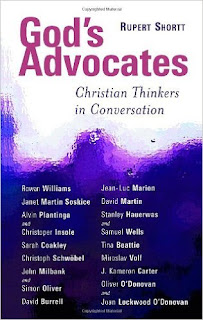 This book has been around for over a decade. It deserves a wider reading than (at least from my observations) it appears to have had. It consists of 'conversations' (but think seminar-room conversations rather than fireside chats!) between the editor, Rupert Shortt and 18 leading Christian thinkers from largely English-speaking contexts. All are academics or scholars: "established names and newer voices - in and on the fringes of the Anglophone world" (ix). Whilst acknowledging the largely Western (both theological and cultural) provenance of his conversation partners, Shortt points out that they represent a certain diversity (and there is certainly theological, ethnic, gender, and generational-diversity among his chosen theologians). Yet he also points to a certain consensus among them: "if my collaborators have a premise in common, it is that theology has recovered its nerve notably in recent years, especially in North America and Britain, and this confidence springs from renewed esteem for Christianity's core resources rather than a thirst for simplistic certainties" (ix). They are, in other words, united by a certain kind of ressourcement - in defiance of both secularism's and modern theology's ambivalence towards, if not rejection of, ancient wisdom. Yet all are equally oriented to the contemporary challenges of faith: issues of gender, race, medical ethics, sexuality, pacificism, linguistics, epistemology, Christian-Muslim relations, and many others are the fields where the ideas of classical Christianity are brought into play.
So who are Shortt's conversation partners? The full list is as follows: Rowan Williams, Janet Martin Soskice, Alvin Plantinga, Christopher Insole, Sarah Coakley, Christoph Schwobel, John Milbank, Simon Oliver, David Burrell, Jean-Luc Marion, David Martin, Stanley Hauerwas, Samuel Wells, Tina Beattie, Miroslav Volf, J. Kameron Carter, Oliver O'Donovan and Joan Lockwood O'Donovan. The conversations are presented in 14 chapters: ten are one-on-one conversations; four have the conversationalists in pairs. My own engagement varied across the chapters - some were discussing issues beyond my immediate interests whilst others were engaged with authors whose work I try to follow as closely as I can. Yet even in the case of the theologians whose work I follow, the conversational style opens up new insights into their thoughts and, perhaps more interestingly, their motivations (often drawn out quite intentionally and cleverly by Shortt).
So whilst commending the whole book as well worth reading, I will focus in this summary on the four conversations that most engaged me.
The conversation with Rowan Williams is, unsurprisingly, very wide ranging. It's a reminder, too, of how pivotal Williams himself has been in the ressourcement highlighted in this book. In this particular chapter, Shortt presses Williams on some basic objections to Christian faith, as well as the evolution of his own thought. They also discuss the overall coherence of Christian ideas. Williams finds this coherence in something of the shared orientation to the 'dislocation' generated by Jesus' death and resurrection. This is Christocentric theology whose very specific centre is a very particular puzzle. Williams is worth quoting on this point at length:
 One of Williams' contemporaries at Cambridge at that time was Sarah Coakley. Coakley reports, however, that her own frustrations with 1970s/80s theology were somewhat different than those of Williams. For her, the theology of that period wasn't 'liberal' enough, and this led to a focus on Ernst Troeltsch in her early research. Yet her engagement with Troeltsch yielded a tension-filled outcome. She found that Troeltsch's historicist revisionist Christology led nowhere: "nothing much was left" (p.69). But there was another strand to Troeltsch' theology which she found more productive: it was his emphasis on Christ mysticism (which, on her reading, Troeltsch never reconciled to his doctrinally revisionist Christology). This allowed her "to glimpse that our approach to 'Christ' really can't be restricted by this sort of historical positivism: it must be that 'Christ' is available in other ways" (p.71). Ultimately, this led her to approach to theology "starting on my knees". This has results, as readers of her subsequent work will know, in a striking integration of systematic theology and prayer. Her reflections in this interview on her first moves in this direction are crystallised in this comment:
 Another of Shortt's conversation partners who brings feminism into critically constructive dialogue with classical theology is Tina Beattie. Again, it is a wide-ranging and nuanced conversation which Shortt records. To my mind the most interesting case of ressourcement to which Beattie points is around the issue of sin. She both stresses the conventional - and some not so conventional - feminist critiques of classical accounts of sin. She appears dissatisfied with the dismissal of the idea of sin by some feminists as either an anachronistic or androcentric concept. At the same time, she draws on the feminist insight that "Christian ideas of sin are heavily invested with an unexamined fear of female sexuality" (p. 200). She clearly believes that the topic of sin needs deeper reflection than either the tradition or the feminist critique has offered. "Feminists", she writes, "need to take seriously the question of sin as a mysterious but profoundly personal experience of alienation and distorted desire which does seem to be part of the human condition, and this can't simply be attributed to the effects of patriarchy" (p.200). After a reference to Freud, she continues: "Whether you call it original sin or the Oedipus complex, there's wisdom about human nature in these terms, and it needs a deeper theological response than criticising unjust social structures" (p.201). This is not a retreat from the feminist task, but a call to enter it more deeply, a call which must be accompanied by patience:
 If feminist theology will strike some as an unexpected location of theological ressourcement, black theology is likely to be even more unexpected. Yet, Shorrt's conversation with J Kameron Carter, professor of Systematic Theology and Black Church Studies at Duke University, offers a very fertile discussion between black theology and Christian orthodoxy. Carter's claim that the "category of culture must be baptised...before [theology] makes use of it" (p. 243) captures much of his approach - and of his critique of liberal theology. On his reading, this is what liberal theology, and not least in its 'black' versions, failed to do. 'Culture' was regarded as self-evidently theologically significant. What is interesting in Carter's critique, however, is that he sees this move in liberal theology as the manifestation, not of novelty, but of a deep rooted tendency in historic Christian theology. The prioritisation of culture is a choice for one side of the binary, the ancient roots of which lie in differences Alexandrian and Antiochene Christologies. Today we describe the binary as one of 'theology from below' or 'theology from above'. Carter believes that this binary must be subverted. To do so he appeals to a theology as ancient as the binary itself: Chalcedon! It is the classic - Chalcedonian - conviction that "in Christ there is no break between his humanity and divinity" which gives Carter critical leverage against liberal theology - and indeed, against both 'white theology' and its binary opposite, 'black theology'. He sets out this argument as follows:
There are many steps in this argument, and the above quotation barely skims the surface (the argument is developed at length in his Race: A Theological Account (OUP, 2008)). It is theologically deeper than a conventional critique of essentialism. There are two especially intriguing dimensions to it. Firstly, he draws on none other than the twentieth-century Catholic theologian Henri de Lubac (quite something for a young black American Baptist theologian to do!) to make his point. He appeals to de Lubac's insistence that nature cannot be abstracted from grace. When theology appeals to culture (as something 'natural') it indulges in precisely such an abstraction. The second is the strong historical connection he makes between the tendency of classic Christianity to de-Judaising of Jesus and Christian theology's frequent blindness to race.
Carter's attempt to bring black theology and orthodoxy into conversation takes some of its force from his reference to the nineteenth-century black political activist, Maria Stewart (1803-1979). Carter points out that Stewart's activism was fuelled in part by "important scriptural-exegetical work" as well as ideas "deriving from such figures as Julian of Norwich" (p.239). He claims that this very early engagement with classic Christian traditions and theologies has been "largely discarded in the modern evolution of racial discourse" (p.239). His own approach to is to retrieve and develop that earlier tradition.
Shorrt's conversation with Carter concludes with Carter reflecting on his involvement at Mount Level Baptist Church in Durham, N.C., where he is an associate minister. One sentence alone of this section is worth quoting, and it is an important reminder of the real benchmark of theology - perhaps especially if it is an instance of ressourcement - whilst also being a reminder of why theology matters in the first place: "Theological discourse, no matter it orientation, will always have its deepest witness in the lives it is able to produce" (p.246).
This is a good book which greatly rewards a reading of even some of its chapters. To an extent it is a 'report' on some of the key theologians writing in English today. It provides fresh insights into the intellectual vibrancy of classic Christian theology. It also offers some interesting windows into the personal and intellectual biographies of thinkers who are otherwise known only through their formal academic writing. The book would be useful to theological students and, indeed, to anyone with some background in theology who would like to get an idea of who's thinking what in the contemporary Anglophone theological world. I suspect that few readers would get through the book without having some of the prevailing caricatures about English-language theology and theologians unsettled.
(This series of 'books worth reading' engages an eclectic selection of books: some directly related to my teaching, some to the UCA, and some of more general theological interest. They are not offered as technical book reviews, but as summaries which highlight why I think they might be useful resources, good conversation starters, or volumes that make helpful contributions to scholarly debate.)
 This book has been around for over a decade. It deserves a wider reading than (at least from my observations) it appears to have had. It consists of 'conversations' (but think seminar-room conversations rather than fireside chats!) between the editor, Rupert Shortt and 18 leading Christian thinkers from largely English-speaking contexts. All are academics or scholars: "established names and newer voices - in and on the fringes of the Anglophone world" (ix). Whilst acknowledging the largely Western (both theological and cultural) provenance of his conversation partners, Shortt points out that they represent a certain diversity (and there is certainly theological, ethnic, gender, and generational-diversity among his chosen theologians). Yet he also points to a certain consensus among them: "if my collaborators have a premise in common, it is that theology has recovered its nerve notably in recent years, especially in North America and Britain, and this confidence springs from renewed esteem for Christianity's core resources rather than a thirst for simplistic certainties" (ix). They are, in other words, united by a certain kind of ressourcement - in defiance of both secularism's and modern theology's ambivalence towards, if not rejection of, ancient wisdom. Yet all are equally oriented to the contemporary challenges of faith: issues of gender, race, medical ethics, sexuality, pacificism, linguistics, epistemology, Christian-Muslim relations, and many others are the fields where the ideas of classical Christianity are brought into play.
So who are Shortt's conversation partners? The full list is as follows: Rowan Williams, Janet Martin Soskice, Alvin Plantinga, Christopher Insole, Sarah Coakley, Christoph Schwobel, John Milbank, Simon Oliver, David Burrell, Jean-Luc Marion, David Martin, Stanley Hauerwas, Samuel Wells, Tina Beattie, Miroslav Volf, J. Kameron Carter, Oliver O'Donovan and Joan Lockwood O'Donovan. The conversations are presented in 14 chapters: ten are one-on-one conversations; four have the conversationalists in pairs. My own engagement varied across the chapters - some were discussing issues beyond my immediate interests whilst others were engaged with authors whose work I try to follow as closely as I can. Yet even in the case of the theologians whose work I follow, the conversational style opens up new insights into their thoughts and, perhaps more interestingly, their motivations (often drawn out quite intentionally and cleverly by Shortt).
So whilst commending the whole book as well worth reading, I will focus in this summary on the four conversations that most engaged me.
The conversation with Rowan Williams is, unsurprisingly, very wide ranging. It's a reminder, too, of how pivotal Williams himself has been in the ressourcement highlighted in this book. In this particular chapter, Shortt presses Williams on some basic objections to Christian faith, as well as the evolution of his own thought. They also discuss the overall coherence of Christian ideas. Williams finds this coherence in something of the shared orientation to the 'dislocation' generated by Jesus' death and resurrection. This is Christocentric theology whose very specific centre is a very particular puzzle. Williams is worth quoting on this point at length:
Shortt and Williams also briefly exchange some reflections on the significance to English-language theology of The Myth of God Incarnate, the publication of which in 1977 is highlighted by Williams as the turning point of Anglophone theology away from the liberal Protestantism which had prevailed in (at least British) academic circles for several decades. If this is where "rational revisionism" (p.16) was leading then it wasn't leading to very much. Referring to conversations with colleagues in the 1980s, he writes: "We shared a sense that we needed to get ourselves out of this rather narrow and oddly cosy liberal environment into a slightly intellectually more rigorous, spiritually more challenging - and even alarming - world. So, yes, there is a move away from what I think of as that rather pale liberal Protestant consensus." (p.17).As for the coherence of the ideas of Christianity, everything evolves like the oak from the acorn out of that sense of dislocation that comes around the death and resurrection of Jesus. If Jesus is the one who now and for ever decides, determines, who is in the company of God, who is in the favour of God, who belongs to the people of God, then the authority, the inner solidity of who Jesus is, has to be connected with the very purpose of God, what God is about. Jesus acts as if he has the right to determine who belongs to the people of God. And he does that in welcome, in forgiveness and judgement all the other things that the Gospels spell out. And therefore, if you take him seriously, you have at some point to make the connection with, as I say, what God is about, what are the purposes of God, the desires of God. And distinctively Christian theology beings to take shape when those two things are brought together: the actions and the words and the sufferings of this particular human being, and the vision of a God whose purpose is unrestricted fellowship with the human beings that he's made (p.3).

 One of Williams' contemporaries at Cambridge at that time was Sarah Coakley. Coakley reports, however, that her own frustrations with 1970s/80s theology were somewhat different than those of Williams. For her, the theology of that period wasn't 'liberal' enough, and this led to a focus on Ernst Troeltsch in her early research. Yet her engagement with Troeltsch yielded a tension-filled outcome. She found that Troeltsch's historicist revisionist Christology led nowhere: "nothing much was left" (p.69). But there was another strand to Troeltsch' theology which she found more productive: it was his emphasis on Christ mysticism (which, on her reading, Troeltsch never reconciled to his doctrinally revisionist Christology). This allowed her "to glimpse that our approach to 'Christ' really can't be restricted by this sort of historical positivism: it must be that 'Christ' is available in other ways" (p.71). Ultimately, this led her to approach to theology "starting on my knees". This has results, as readers of her subsequent work will know, in a striking integration of systematic theology and prayer. Her reflections in this interview on her first moves in this direction are crystallised in this comment:
I had therefore to rediscover a vibrant and distinct sense of the Spirit, starting on my knees, before I could return to those lost strands of Christology and the Trinity that I seemed to have utterly dismantled in my Troeltschian 'liberal' quest. First, one has to go through this passage of handing over the reins of control to the Spirit; only then does one begin to see that the theologian who tries to speak of God - stammeringly - is always already engaged in a divine process that is going on all the time (p.71).This 'handing over the reins' has deeply influenced her approach to systematic theology, a discipline which she argues - against convention - is consistent with her feminist commitments. For Coakley, systematics is legitimate "attempt to enunciate a coherent vision", but with this proviso: "as long as systematics is undergirded by the disciplined 'practice' of non-mastery, such that theology itself is always in via, always undergoing its own apophatic displacement" (p.76f). Coakley has, of course, gone on to produce a systematic theology oriented to issues of gender, sexuality and desire. In doing so she has engaged, through her extensive appeal to patristic theologians, in one of the more interesting exercises in ressourcement in contemporary theology.
 Another of Shortt's conversation partners who brings feminism into critically constructive dialogue with classical theology is Tina Beattie. Again, it is a wide-ranging and nuanced conversation which Shortt records. To my mind the most interesting case of ressourcement to which Beattie points is around the issue of sin. She both stresses the conventional - and some not so conventional - feminist critiques of classical accounts of sin. She appears dissatisfied with the dismissal of the idea of sin by some feminists as either an anachronistic or androcentric concept. At the same time, she draws on the feminist insight that "Christian ideas of sin are heavily invested with an unexamined fear of female sexuality" (p. 200). She clearly believes that the topic of sin needs deeper reflection than either the tradition or the feminist critique has offered. "Feminists", she writes, "need to take seriously the question of sin as a mysterious but profoundly personal experience of alienation and distorted desire which does seem to be part of the human condition, and this can't simply be attributed to the effects of patriarchy" (p.200). After a reference to Freud, she continues: "Whether you call it original sin or the Oedipus complex, there's wisdom about human nature in these terms, and it needs a deeper theological response than criticising unjust social structures" (p.201). This is not a retreat from the feminist task, but a call to enter it more deeply, a call which must be accompanied by patience:
[I]t's premature to expect feminist theology come up with adequate solutions to these vast issues that it opens up. After all it took the early Church over three centuries and much political wrangling to get around to the Council of Nicaea. We might have to wait a few centuries yet before we have a Council of Lesbos that gives doctrinal recognition to women's theological insights (p.201).
 If feminist theology will strike some as an unexpected location of theological ressourcement, black theology is likely to be even more unexpected. Yet, Shorrt's conversation with J Kameron Carter, professor of Systematic Theology and Black Church Studies at Duke University, offers a very fertile discussion between black theology and Christian orthodoxy. Carter's claim that the "category of culture must be baptised...before [theology] makes use of it" (p. 243) captures much of his approach - and of his critique of liberal theology. On his reading, this is what liberal theology, and not least in its 'black' versions, failed to do. 'Culture' was regarded as self-evidently theologically significant. What is interesting in Carter's critique, however, is that he sees this move in liberal theology as the manifestation, not of novelty, but of a deep rooted tendency in historic Christian theology. The prioritisation of culture is a choice for one side of the binary, the ancient roots of which lie in differences Alexandrian and Antiochene Christologies. Today we describe the binary as one of 'theology from below' or 'theology from above'. Carter believes that this binary must be subverted. To do so he appeals to a theology as ancient as the binary itself: Chalcedon! It is the classic - Chalcedonian - conviction that "in Christ there is no break between his humanity and divinity" which gives Carter critical leverage against liberal theology - and indeed, against both 'white theology' and its binary opposite, 'black theology'. He sets out this argument as follows:
[F]ormulating a 'black Christology'..., at least as typically conceived, is problematic. Put succinctly, it risks replicating the very procedures of 'white theology' namely, of operating out of a notion of 'pure nature' as culturally inflected through the notion of whiteness. ... White theology has too often functioned from a position of pure nature, a nature that is so pure that white theology need not name itself as 'white', for it is 'natural', indicative of the 'true state and proper order of things.... [T]o formulate a 'black Christology' or a 'black systematics' as typically conceived is to risk replicating this procedure, where 'black' comes to function in an essentialised or 'pure' manner (p. 242).
There are many steps in this argument, and the above quotation barely skims the surface (the argument is developed at length in his Race: A Theological Account (OUP, 2008)). It is theologically deeper than a conventional critique of essentialism. There are two especially intriguing dimensions to it. Firstly, he draws on none other than the twentieth-century Catholic theologian Henri de Lubac (quite something for a young black American Baptist theologian to do!) to make his point. He appeals to de Lubac's insistence that nature cannot be abstracted from grace. When theology appeals to culture (as something 'natural') it indulges in precisely such an abstraction. The second is the strong historical connection he makes between the tendency of classic Christianity to de-Judaising of Jesus and Christian theology's frequent blindness to race.
Carter's attempt to bring black theology and orthodoxy into conversation takes some of its force from his reference to the nineteenth-century black political activist, Maria Stewart (1803-1979). Carter points out that Stewart's activism was fuelled in part by "important scriptural-exegetical work" as well as ideas "deriving from such figures as Julian of Norwich" (p.239). He claims that this very early engagement with classic Christian traditions and theologies has been "largely discarded in the modern evolution of racial discourse" (p.239). His own approach to is to retrieve and develop that earlier tradition.
Shorrt's conversation with Carter concludes with Carter reflecting on his involvement at Mount Level Baptist Church in Durham, N.C., where he is an associate minister. One sentence alone of this section is worth quoting, and it is an important reminder of the real benchmark of theology - perhaps especially if it is an instance of ressourcement - whilst also being a reminder of why theology matters in the first place: "Theological discourse, no matter it orientation, will always have its deepest witness in the lives it is able to produce" (p.246).
This is a good book which greatly rewards a reading of even some of its chapters. To an extent it is a 'report' on some of the key theologians writing in English today. It provides fresh insights into the intellectual vibrancy of classic Christian theology. It also offers some interesting windows into the personal and intellectual biographies of thinkers who are otherwise known only through their formal academic writing. The book would be useful to theological students and, indeed, to anyone with some background in theology who would like to get an idea of who's thinking what in the contemporary Anglophone theological world. I suspect that few readers would get through the book without having some of the prevailing caricatures about English-language theology and theologians unsettled.
* * * * *
(This series of 'books worth reading' engages an eclectic selection of books: some directly related to my teaching, some to the UCA, and some of more general theological interest. They are not offered as technical book reviews, but as summaries which highlight why I think they might be useful resources, good conversation starters, or volumes that make helpful contributions to scholarly debate.)
Wednesday, January 27, 2016
Does this confess the 'faith of the church'?
 Late last year, I began pondering what issues I would want to contribute to a contemporary statement of the church's trinitarian faith. This was prompted by several factors. Conversations in China last November with colleagues from the United Church of Canada reminded me of that church's history of writing statements of faith. The encouragement of my own church's Basis of Union to confess the church's faith in fresh words and deeds is a constant presence to my theological work. More sustained teaching in Christology and Trinity in recent semesters has led me to engage more explicitly with the continuing discussions about gender, the theological significance of the specifics of Jesus' humanity, and the eschatology of the New Testament - all issues where the classical creeds are problematic. At the same time my conviction grows that the 'faith of the church', including its trinitarian content and structure, remains a fruitful source of wisdom; it warrants critical re-articulation rather than dismissal on the grounds of either its allegedly primitiveworldview or its alleged captivity to Greek metaphysics. For that reason I believe that any contemporary statement of faith succeeds to the extent that it is a fresh confession of the faith of the church and it fails to the extent it that it is an idiosyncratic statement of individual belief. Learning to use statements of faith as confessions of who we 'trust' rather than as lists of things to 'believe' is, in my view, an important spiritual challenge for the contemporary church.
 The result of these various promptings is below. It will be evident that some of my criteria are in tension with each other (e.g., I've deliberately retained the word 'Lord' to reflect the biblical witnesses' own re-framing of the term). Specific echoes of the Basis will be very easily heard. I post the statement here for reflection and comment. It remains a work in progress and I'd value both critique and suggestions for improvement.
* * * *
We trust one God: the Love, Life and Truth who is the source and sustainer of all that was, is and will be.
We trust Jesus Christ, Love from Love, Life from Life, Truth from Truth, Eternity’s Wisdom, Creation’s Lord, Israel's Messiah, God among us.
Sent from the very
heart of God's love for the world, he became human in the womb of Mary. He came
not to be served but to serve.
Hailing from Nazareth, he proclaimed the long-promised and coming reign of God; he befriended outcasts, healed the sick, forgave sinners, confronted falsehood, and showed mercy to his enemies.
Hailing from Nazareth, he proclaimed the long-promised and coming reign of God; he befriended outcasts, healed the sick, forgave sinners, confronted falsehood, and showed mercy to his enemies.
Reaching Jerusalem, riding
a donkey, prompting hosannas, he offered himself as the servant Lord; he was
rejected, abandoned and betrayed; he was crucified on a Roman cross as a false
Messiah.
Dead in Joseph of
Arimathea’s tomb, God raised
him; the human verdict was reversed; his mission was vindicated; his
reconciliation of the world to God was declared.
Appearing, speaking
and eating, his transformed body provoked fear, doubt, joy and hope; his resurrection
announced the defeat of death; he reassured his confused followers and
commissioned them as witnesses to his way, truth and life.
Returning, now scarred
and bruised, to the One who sent him, he shares in Love’s rule and receives the worship of his sisters and brothers from
every culture, class and nation.
We trust the Holy Spirit, the loving and lively
breath of God, who flows in, around and within the whole creation.
This same Spirit spoke
through Israel's prophets, inspired Jesus' ministry, and gathers a community,
the church, through which Christ bears witness to himself.
Sent by the Spirit,
the church, like Jesus, is called to serve; in ever-fresh words and deeds, it is
to proclaim the risen crucified Jesus Christ; its vocation is to witness to
God's renewal of all creation, for which it waits with an impatient but sure
and active hope.
This is the church’s faith. In this Triune God we trust. God grant us
so to live. Amen.
* * * *
Saturday, January 23, 2016
Audio Links to Lectures by Williams and McFarland from Cambridge Divinity
The Divinity Faculty at Cambridge has posted audio files of the first two of Rowan Williams' Hulsean Lectures. Both are available via this link. Subsequent lectures will be posted as the series continues. There are four more to go. The Series is entitled Christ and the Logic of Creation.


Ian McFarland's inaugural lecture as the Regius Professor of Divinity has also been made available. Go to this link. McFarland's topic: The Crucial Difference: For a Chalcedonianism Without Reserve.


Ian McFarland's inaugural lecture as the Regius Professor of Divinity has also been made available. Go to this link. McFarland's topic: The Crucial Difference: For a Chalcedonianism Without Reserve.
Sunday, January 17, 2016
The 'Same God?' Controversy: Some Other Questions
The 'Same God?' controversy at Wheaton College rages on. An issue of evangelical loyalty
and identity has opened up into an issue of interest to a much wider range of
Christians. Probably unsurprisingly, a discussion about Christian-Muslim relations has exposed some of the contemporary fault lines internal to Christianity.
I have nothing to add to the theological discussion
directly, but there are a few things about the discussion that strike me as
being slightly askew. Or, more specifically, I wonder if we are trying to force one theological question to do more theological work than it is reasonable to expect it to do. What
follows, therefore, consists of an observation, some other questions, a concern, and a
personal reflection.
An observation
Both the content and the tone of much of the discussion seems to suggest a background assumption that if we have our doctrine of God right, then our worship will be true and faithful. But the various theological traditions of Christianity, and I’m sure those of Islam also, have long taught otherwise. Wisely taught and used, doctrines are, in Nicholas Lash’s felicitous words, 'protocols against idolatry'. But taught and used without wisdom, they are as prone to becoming idols as is any material object or hidden ambition. Trinitarian doctrine may well be a true guide to true worship (something I definitely affirm), but in no way does adherence to Trinitarian doctrine guarantee true worship. Christians are called to worship in Spirit and in Truth (John 4:24) and to make their lives their worship (Rom 12:1). Such worship requires an orientation of body, soul and mind to a range of practices and convictions, not simply to a particular doctrine of God. So it seems to me that the question of whether Christians and Muslims worship the same God can’t actually be answered by comparing respective doctrines of God (even if that comparison will be one element informing the answer).
Both the content and the tone of much of the discussion seems to suggest a background assumption that if we have our doctrine of God right, then our worship will be true and faithful. But the various theological traditions of Christianity, and I’m sure those of Islam also, have long taught otherwise. Wisely taught and used, doctrines are, in Nicholas Lash’s felicitous words, 'protocols against idolatry'. But taught and used without wisdom, they are as prone to becoming idols as is any material object or hidden ambition. Trinitarian doctrine may well be a true guide to true worship (something I definitely affirm), but in no way does adherence to Trinitarian doctrine guarantee true worship. Christians are called to worship in Spirit and in Truth (John 4:24) and to make their lives their worship (Rom 12:1). Such worship requires an orientation of body, soul and mind to a range of practices and convictions, not simply to a particular doctrine of God. So it seems to me that the question of whether Christians and Muslims worship the same God can’t actually be answered by comparing respective doctrines of God (even if that comparison will be one element informing the answer).
Some other questions
 The above issues have led me to wonder whether some of the various
theological expositions which have emerged in recent weeks have unwittingly
been answering a question quite different to the one they think they are
answering. They are actually answers to the question of whether Christian
monotheism and Islamic monotheism are the same. Regardless of how that question
is answered, it is a different question to whether Christians and Muslims worship the same God. Both questions are
perfectly legitimate and properly warrant deep theological reflection. Perhaps,
however, an equally fruitful question would be to ask what each tradition means
by worship and how it is practiced. For
it seems to me that practices of worship will tell us at least as much - and arguably even more - about the
object of our worship as will a doctrine of God. From that question a couple of
others also flow. What are the teachings of Islam which are reflected in
Islam’s various worship practices? Are there aspects of both the worship
practices and their underlying theologies from which Christians and Muslims might learn from each other? It
seems to me that each of these questions is logically distinct (if not
completely unrelated) to the question of whether Christians and Muslims worship
the same God.
The above issues have led me to wonder whether some of the various
theological expositions which have emerged in recent weeks have unwittingly
been answering a question quite different to the one they think they are
answering. They are actually answers to the question of whether Christian
monotheism and Islamic monotheism are the same. Regardless of how that question
is answered, it is a different question to whether Christians and Muslims worship the same God. Both questions are
perfectly legitimate and properly warrant deep theological reflection. Perhaps,
however, an equally fruitful question would be to ask what each tradition means
by worship and how it is practiced. For
it seems to me that practices of worship will tell us at least as much - and arguably even more - about the
object of our worship as will a doctrine of God. From that question a couple of
others also flow. What are the teachings of Islam which are reflected in
Islam’s various worship practices? Are there aspects of both the worship
practices and their underlying theologies from which Christians and Muslims might learn from each other? It
seems to me that each of these questions is logically distinct (if not
completely unrelated) to the question of whether Christians and Muslims worship
the same God.
A concern
 The current controversy has not arisen out of an abstract doctrinal
dispute. When Larycia Hawkins affirmed her belief that Christians and Muslims worship the same God, she did so as one of several justifications of her
hijab-wearing act of solidarity with Muslims, a solidarity intended to counter the loud anti-Muslim
voices emerging from North American Christianity. The intention is exemplary. The
hijab-wearing act is of immense symbolic power, and one that I personally find
very moving (whilst acknowledging that the response from Muslims is not unanimous). But there is, I think, a
risk in justifying such solidarity on the basis of "religious solidarity" based, in turn, on the belief that Muslims and Christians
worship the same God. Even if both do worship the same God,
Christian solidarity with Muslims against those who would demonise them is
properly justified (as it was by Professor Hawkins) by a concern for such matters as love of neighbour, befriending
the stranger, respect for the dignity of all humans, and not bearing false witness. Professor Hawkins’ act of
solidarity would be perfectly justified and no less exemplary even if it was
unequivocally the case that Muslims and Christians did not worship the same God.
The current controversy has not arisen out of an abstract doctrinal
dispute. When Larycia Hawkins affirmed her belief that Christians and Muslims worship the same God, she did so as one of several justifications of her
hijab-wearing act of solidarity with Muslims, a solidarity intended to counter the loud anti-Muslim
voices emerging from North American Christianity. The intention is exemplary. The
hijab-wearing act is of immense symbolic power, and one that I personally find
very moving (whilst acknowledging that the response from Muslims is not unanimous). But there is, I think, a
risk in justifying such solidarity on the basis of "religious solidarity" based, in turn, on the belief that Muslims and Christians
worship the same God. Even if both do worship the same God,
Christian solidarity with Muslims against those who would demonise them is
properly justified (as it was by Professor Hawkins) by a concern for such matters as love of neighbour, befriending
the stranger, respect for the dignity of all humans, and not bearing false witness. Professor Hawkins’ act of
solidarity would be perfectly justified and no less exemplary even if it was
unequivocally the case that Muslims and Christians did not worship the same God.
A personal reflection

At a personal level, the controversy has brought to the
surface some long dormant memories of issues that first emerged for me when I
worked for several years in Pakistan back in the 1980s. Then an Agronomist, I
was theologically very naïve (in hindsight, embarrassingly so) and I satisfied
myself with what were some pretty unsophisticated understandings of Islam. But
the question now provoked by the Wheaton controversy is one that I could not
help but ask as I daily woke to the call of the minaret from the adjacent
mosque, or as I observed faithful Muslims pausing from their work and bowing
towards Mecca as I busily drove along the highway to and from my work, or as I
would walk around the truly sublime seventeenth-century Badshahi Mosque, just a
couple of kilometres from where I lived. In fact, it is the architecture of
that remarkable mosque which still stirs a theological question for me. The capacious welcome of its vast open
spaces, its smooth sweeping arches, its gently curved domes, and its starkly
simple minarets – features it shares with the other grand mosques of Moghul
India - managed to point me to God’s
grandeur and simplicity more eloquently than the often-cluttered naves, the
dark-vaulted rooves and the jagged, intrusive
spires of Christendom's gothic cathedrals. Can
such reactions be legitimate prompts to ask a different question than the one
generating the current controversy? For instance: What is the theological insight in Islam
that has generated such beauty and is there wisdom in that insight from
which Christians can learn? Again, it
seems to me that such questions are independent of the answer to the question
of whether Christians and Muslims worship the same God.
* * * * *
My thanks to Jason Goroncy for some helpful responses to an earlier draft of this blog. Jason's own reflections on the issue can be found here.
Subscribe to:
Posts (Atom)