Showing posts with label systematic theology. Show all posts

Wednesday, January 19, 2022

Christianity's Big Ideas: Tuesday nights at Pilgrim

I'll be teaching this unit at Pilgrim Theological College on Tuesday evenings (6.00pm-9.00pm) during  Semester 1, commencing on February 22nd. 

The unit is the entry-level introduction to what might otherwise be known as systematic theology or  Christian doctrine. Those terms do point to particular ways of thinking and studying, but whichever is preferred, they deal with the ideas that have classically characterised Christian thought: God, revelation, creation, humanity, Christology, redemption, church, hope etc.

In addressing these topics as Christianity's 'big ideas,' I take the opportunity to explore how, precisley as ideas, they have emerged and developed in the midst of intellectual debate, political struggles, apologetic defense and contextual revision. Sometimes they have defended the Christian and wider status quo, other times they have been tools for deconstructing the status quo and constructing new visions of life. Sometimes these ideas have inspired individuals and communities to love and service, other times they have legitimated arrogance and division. 

Something I'll be highlighting in this year's iteration of the unit will be the theme of 'conversation.' What conversations produced the ideas that Christianity has inherited and what conversations should these ideas be part of today? These conversations can be internal to the church (across time and place), at the interface between the church and the wider communinty or they can be conversations in the wider community to which the church listens in. 

Therefore, as well taking time to introduce a broad range of classical theological topics and styles of theology, the following are some of the topics and conversations which will be addressed at various points along the way:

  • Theology and Revelation: What can be learnt in conversations between received theological knowledge and ancient wisdoms?
  • Scritpure: How does the Christian doctrine of scripture relate to popular discussions about 'sacred' texts?
  • Jesus Christ: Who is the Jesus invoked in attempts to defend the so-called Judeo-Christian tradition?
  • Church: How might the church contribute to discussions about the post-secular west?
  • Human being: What can a Christian anthropology contribute to the critique of neoliberalism?
  • Hope: What can Christian discussions about hope learn from climate change activism?

The unit is both face-to-face and online synchronous. You can read the official unit description and check out the details of the learning outcomes, assessments and readings at these links: undergraduate face-to-faceundergraduate online synchronouspostgraduate face-to-facepostgraduate online synchronous.

For enrolment enquiries, contact Pilgrim's Registrar at: study@pilgrim.edu.au

For any specific enquiries abvout the unit content, contact me at geoff.thompson@pilgrim.edu.au

Tuesday, January 16, 2018

Christianity's Big Ideas

This coming semester I'll be teaching 'Christianity's Big Ideas'. I'm hoping to subvert the negative baggage that attaches to 'doctrine' and 'systematic theology' by starting from the fact that Christian faith provoked new and controversial ideas. I also want to subvert the view that ideas are simply reducible to the material circumstances of their production and instead to foster a confidence in the continuing intellectual generativity of the Christian faith in a world full of competing and contested ideas. Theological ideas actually matter and are one means the church has as its disposal for truth-telling.

The unit will be running 2-5 pm on Thursday afternoons during semester. Check www.pilgrim.edu.au for semester dates and further details. First lecture is on Thursday March 1st.

Below is the twitter thread I recently tweeted about the course.

*Jesus: an unexpected messiah.* 1/2 The emergence the movement called Christianity rested on the proclamation of the crucified Jesus of Nazareth as Israel’s messiah. A crucified messiah was a pretty big idea. No such proclamation, no Christianity.

*Jesus: an unexpected messiah.* 2/2 This link of crucifixion with messiahship was unconventional and controversial, but it also generated other big ideas from within the Christian community, many of them sadly obscured in later Christianity.

*God is love.* Too easily taken to be a self-evident theological truth. Not so in the ancient world. Jews certainly believed that God showed constant love. And Christians developed this conviction on the basis of Jesus’ life, death and resurrection. One of Christianity’s biggest ideas.

*Incarnation & Trinity: God is not aloof.*1/2  These doctrines aren’t simply Greek exaggerations of early claims about Jesus. Nor are they simply about Jesus’ status.

*Incarnation & Trinity: God is not aloof.*2/2  They are also statements of Xn understanding of God/World relationship. God becomes human without any loss of divinity. God relates to the world in this way because God is relation. These were very big ideas in the ancient world

*Salvation: cosmic in scope.* Much Christian discourse about salvation is trapped in piety and individualism – and in combinations thereof. Based on the resurrection of Jesus, some strands of the New Testament point to salvation as a cosmic restoration. It would be hard to get a bigger idea.

*Salvation: redemption not escape.* Early Christian thinking about salvation built on Jewish beliefs  about a renewal of this world, not an escape from it or a destruction of it. Belief in Jesus' resurrection fine-tuned this conviction for Christians.

*The Spirit: a materialist spirituality.* Biblical language of spirit, soul, body, flesh can all be confusing. The Spirit and matter not opposites. The Spirit’s work is to be seen in such concrete realities as the church, lives of service and communities of reconciliation, truth-telling, and justice-making.

*The church: God’s new politics.* 1/2 Early Christian communities were not spiritual enclaves for contemplation or satisfying 'spiritual' needs. They were unconventional communities working out discipleship in the context of tensions about money, food, sex and power.

*The church: God’s new politics.* 2/2 They were a particular form of social organisation. Mainline churches are still trying to get their heads around this big idea, so essential for the post-Christendom context.

*Scripture: 2-volume, uneven anthology.* 1/2 NT scholar Gerd Theissen warned re downplaying the radicalness and theological significance of adding Christian literature to the Hebrew canon. Accepting a two-volume scripture was itself a big idea.

*Scripture: 2-volume, uneven anthology.* 2/2 The odd collection thus produced invites deep theol reflection on what it is & why we read it, not just how to read it. Read the Bible as an anthology that deals with a big story rather than as a collection of ‘sacred’ ‘texts’.

*Sacraments: Initiating and sustaining mission.* Concept of ‘sacrament’ is fruitful if problematic. It sometimes obscured links b/w baptism, eucharist, discipleship & mission of the church. This big idea was easily lost in Christendom and needs to be renewed in post-Christendom.

*Hope.* Early Christians shifted from expectation of Jesus’ early return to a longer-term hope of God’s ultimate consummation of what was begun in Jesus. This itself was a pretty big shift in ideas. Accordingly, Christian hope is not waiting passively but actively living into God’s future.


*Theology: nurturing the Christian imagination* Weave these big ideas together and you get a Christian vision which, like a work of art, engages the imagination, intellect and heart. As such it serves the church and its worship, witness and service.

Wednesday, May 31, 2017

Books Worth Reading (11): Rachael Keefe's Barefoot Theology: A Dictionary for Pilgrims, Priests and Poets

Raechael A. Keefe, Barefoot Theology: A Dictionary for Pilgrims, Priests and Poets (Eugene: Wipf & Stock, 2013),

Notwithstanding its title this is not the usual sort of theological dictionary. In fact, it's not really the kind of theological book that academic theologians are terribly comfortable with. There are no long historical, exegetical, doctrinal or philosophical discussions. The entry on 'hemenueutics' extends to only four lines. On the other hand, the entry on 'questions' runs to three pages. And, gosh, there is no entry whatsoever for homoousious! Still, I think many theological students would profit from having this book sitting beside their more usual dictionaries, encyclopedias, and textbooks. This dictionary defines through poetry.

Theology is necessarily discursive, analytical, exegetical and historical. But theology is ultimately an imaginative discipline. Precisely as a technical discipline - or set of disciplines - it shapes and reshapes our imagination. In other words, it shapes and reshapes how we imagine God, creation, salvation, Jesus, the Spirit etc. Sadly this is not always immediately apparent to theology students as they engage the technical disciplines required of them. But I think it is one of the responsibilities of a theology teacher to help students grasps the imaginative functions of theology. And that requires providing diverse points of entry into theological work to match the diverse ways that people cultivate their imagination. I know that my imagination is actively engaged and stimulated by engaging with ideas, concepts and texts. But I recognise that this is not the case for many others. That does not mean, however, that we obliged to set aside the conceptual and analytical. It does mean that multiple points of entry into them need to be developed. This is not to deny that the poetic and the artistic do not have an integrity of their own. But as well as that they can helpfully open the imagination to the technical discourses of theology.

If pressed, I would ultimately place this book in the genre of the devotional, but it is devotional in a way that is intentional about speaking to the mind as well as the heart. Let me cite just two examples.

The entry on 'kerygma' is actually built around a mediation on Jesus' encounter with the Samaritan woman. The last stanza of the 'definition' runs as follows:
If we really want that early church preaching
then maybe we should get ourselves to the well
with all the sinners who thirst for Living Water
and are afraid to drink in the presence
of the Word who comes to us
in the fullness of grace and truth
until our testimony pours our
new life
abundantly
And on 'redaction', after several lines  reminding readers of form and grammar, and original languages, the poem, written in a chiastic structure, concludes
These are good to tools to use lest we forget that
every writer has an agenda, a goal, a reason
to spin a story in a certain direction,
especially when politics and
religion are twisted together
lie they were in the
church's very
early days
as they
now
are.

Not all the 'definitions' sit comfortably with me, but the approach Keefe pursues does. Whilst this book could only accompany and not replace other more conventional theological dictionaries, I think for a theological student (regardless of how right- or left-brain they are) to have the meanings of some key theological words expanded by poetry is important. After all, it involves the same kind of imaginative shifts involved when we move from doctrine to prayer and hymns in worship.

****

This (very occasional) series of 'books worth reading' engages an eclectic selection of books: some directly related to my teaching, some to the UCA, and some of more general theological interest. They are not offered as technical book reviews, but as summaries which highlight why I think they might be useful resources, good conversation starters, or volumes that make helpful contributions to scholarly debate.

Saturday, December 17, 2016

Crisp and Sanders on Historical and Systematic Theology


I came across this quote from material I used in teaching last year. It is from the Introduction of Crisp and Sanders, Christology Ancient and Modern: Explorations in Constructive Dogmatics. It was a useful discussion starter in a unit my colleague, Katharine Massam and I taught, The Cracking of Christendom. It was semester-long course exploring the Reformation from both historical and doctrinal perspectives. It is a good summary of the issues at stake in the relationship between historical and systematic theology, in the relationship between doctrinal retrieval and constructive theology.
Theology that ignores the tradition is a thin, insipid thing. It also runs the risk of repeating mistakes that could be avoided by developing greater familiarity with the missteps of our forebears. If theologians do not attempt to dialogue with the past, retrieving the ideas of past thinkers without asset-stripping them, paying attention to the warp and weft of historic theology and the way in which the past may fructify the present, then we risk cutting off our noses to spite our respective faces. We can learn history from those who have gone before us. But they can also teach us how we ought to think, and furnish us with concepts, notions and doctrines that will ensure our theologies are much healthier than would otherwise be the case.
Systematic theology is not the same as historical theology, of course. The systematician will want to make normative, not merely descriptive judgements. But resources for such ends can be furnished by attending to theologians of the past and engaging with them in a collegial manner in order to come to normative conclusions about theology today. Theology that steps back in time only to hide there from the problems to be faced in the present ends up hidebound and moribund. Or, worse, it becomes an empty scholasticism that refuses to attend to the needs of the present, accepting only what has been hallowed by time and use, as if it is sufficient to look backward without looking forward. The constructive theological task is not identical to theological retrieval, however. One must be alive to the differences that inform theology of the past and the cultural, intellectual, and scientific changes that have occurred between then and now.

Oliver D. Crisp and Fred Sanders, "Introduction" in Christology Ancient and Modern: Explorations in Constructive Dogmatics (Grand Rapids: Zondervan, 2013), Location 87-98, Kindle Version. 

Friday, April 29, 2016

What is theology? An interview with Reverend and Smith


I was recently interviewed by Reverend and Smith, a couple of Christian young guys in Brisbane who are seeking to develop a new web-based ministry of theological discussion and debate.

The interview started by exploring what theology, and systematic theology in particular, is. In the end we ranged across a quite wide range of topics about where theology is done and by whom. We also discussed why it is that theology often seems remote from the life of the church. I really enjoyed the experience, and being involved in what is my first podcast. And I even enjoyed Reverend and Smith dissecting my responses afterwards. And, full marks to Reverend and Smith for developing this series of programmes and fostering some serious cyberspace-discussion about theology.

Listen to the interview here.

Tuesday, April 26, 2016

Books Worth Reading (7): Postliberal Theology: A Guide for the Perplexed by Ronald T. Michener


I have never been a card-carrying postliberal theologian. Nevertheless, my engagement with the postliberal theologians of the 1980s and 1990s undoubtedly shaped my approach to the study of theology and, and more enduringly, my interest in the diverse roles of doctrine in the church’s life. Central to the postliberal school was George Lindbeck’s 1986, The Nature of Doctrine: Religion and theology in a Postliberal Age. I read it for the first time just as I embarked on my postgraduate studies. If I can say this without being too presumptuous, it woke me from my doctrinal slumber. It snapped me out of the dreary liberal/conservative rhetoric of the mainline protestant theology I had imbibed by being part of mainline protestant church. Lindbeck’s typology of doctrine –  experiential expressivist, propositional, and cultural-linguistic –  provided  me with quite different and more interesting ways of mapping the theology I was learning. It made me realise that to describe a theological position as liberal or conservative was to say almost nothing intellectually interesting, let alone informative, about that theological position. Moreover, reading Lindbeck made me realise that the study of doctrine and the many functions it performs in the church was at least as interesting, complex and fascinating as the study of hermeneutics or method or the various backgrounds to the biblical writings.

As a specific school of thought, postliberal theology had a relatively short life. Paul de Haart has even written about its rise and decline. The questions it raised, however, are still worth pondering. Indeed, to some extent, they are inevitable in any study of Christian theology, whether or not that study is shaped by exposure to specifically postliberal writings. So, for instance:
  • If doctrines aren’t propositions, what are they?
  • How is narrative related to truth?
  • What is the relationship between theology and practice?
  • Can theology be non-foundationalist without becoming fidestic?
  • Are the discourses of different religions incommensurable?

So the postliberal school may well have passed into history, but if you want to see how postliberal theology brought such questions to focus and how it helps address them, then Ronald T. Michener’s short 2013 book, Postliberal Theology: A Guide for the Perplexed would be a book well worth reading. As with other books in Bloomsbury’s Guide for the Perplexed series, it’s pitched at readers able to engage arguments typical of tertiary education, it provides a helpful overview of the topic without bypassing the critical questions, it is relatively short (140 pages), and it has many helpful suggestions for further reading.

The book consists of 5 chapters. The first, ‘Introduction’, does what its title says. It’s a very general overview of postliberal theology which locates it in the midst of other twentieth-century theological movements. Chapter 2, ‘Background’, provides a very useful summary of the wide range of philosophical, anthropological, sociological and theological backgrounds to the movement. (Throughout this chapter readers would glean some insight into the important contributions to postliberal theology of Augustine, Aquinas and Barth.) Chapter 3, ‘Theological exponents of postliberal theology’ provides sustained engagement with the three major voices of the movement (Frei, Lindbeck, and Hauerwas) and a quick overview of ‘other voices’ (David Kelsey, William Placher, Bruce Marshall, George Hunsinger and Kathryn Tanner). The title of Chapter 4, Problems and Criticisms of Postliberal Theology, speaks for itself as does that of Chapter 5, ‘Prospects and proposals for postliberal theology today’.

So what is 'postliberal theology'? Early on Michener offers what is less a definition and more a set of observations that help to locate this particular theology:
Postliberal theology has always been more a loose connection of narrative theological interests than it is some monolithic agenda. It represents an overarching concern for the renewal of Christian confession over theological methodology. Rather than reliance on  a notion of correlative common experience, postliberal theology moves towards the local or particular faith description of the community of the church (p.3).
As such it is a  "tertium quid solution" between the two major protestant responses to modernity: fundamentalism and liberalism. More specifically, postliberal theology rejects the identity of truth with doctrinal propositions characteristic of fundamentalism. At the same time it rejects the location of truth within a putatively pre-cognitive domain of human experience (of which doctrines are contingent ‘expressions’) typical of liberalism. In contrast postliberal theology locates truth within Christianty’s own practiced and articulated narratives: i.e.,  the narratives that shape the church’s life – creeds, liturgies, scriptures, confessions etc. And here, of course, is what is usually perceived as the major problem with postliberal theology: it so completely internalises truth, that it is essentially sectarian and fideistic.
Of course, postliberal theologians have frequently addressed this question, but the criticism persists. Michener sets out some of these response as well as his own in Chapter 4. In the response to the charge of the inevitably of isolationism which attached to postliberalism, Michener cites the example of the Amish community in Lancaster County, Pennsylvania to the massacre of their schoolchildren in 2006. Here was a community which prima face represents what a postliberal church might be: isolated and so formed by its own internal traditions that it was unable to relate to the world. Yet as Michener indicates, it was precisely that internal formation which enabled this community to practice forgiveness under the most extreme provocation. Michener makes this observation:
This is a remarkable example of how a commitment to one's faith, fully embedeed in the narrative and tradition of that faith, even with (what is often seen as) an extreme sectarian context may still have a radically profound impact on society. The Amish are certainly no friends to modern culture and society. ... [Nevertheless] with no regard to society's value or acts of self-aggrandizement  a faithfully devout community can still have a powereful effect on that society (p. 117).
Now, there are quite properly serious limits to this most extreme example. By itself it should not be taken as a justification for postliberal theology or as a response to a major criticism of it. Nevertheless, it does provide a lived example which calls into question the assumption made in theory that faithfulness to a tradition necessarily leads to public isolation.

The other aspect of Michener's critical discussion which is worth noting relates to the Holy Spirit. A little surprisingly, Michener draws some parallels between Postliberalism and Pentecostalism in their shared rejection of modern reductionist rationality. He quotes James K.A.Smith's reference to Pentecostalism's  "more expansive, affective understanding of what counts as knowledge and a richer understanding of how we know" (Smith, quoted by Michener, p. 136) and suggests this as an area of shared concern. It is not entirely clear where that parallel might lead, but the shared concern is at least worthy of note and any pathway to deeper mutual understanding between mainline and Pentecostal theologies is worth pursuing.

This is a good book. It would be useful to any one already interested in and familiar with postliberal theology. It would also be well worth reading for anyone keen to find out about it for the first time.
* * * *
In second semester this year I'll be teaching a unit, 'Doctrine, Truth and Pluralism'. Although postliberal theology will be only one part of this unit, questions such as those listed above will be the unit's major driving force. It will be taught as a two-part intensive, July 29-30 and Oct 7-9.  Check out this promotional video and the course outline on pp. 92-94 of Pilgrim's 2016 Handbook. The unit will also be available for on-line enrolment.
* * * *
(This series of 'books worth reading' engages an eclectic selection of books: some directly related to my teaching, some to the UCA, and some of more general theological interest. They are not offered as technical book reviews, but as summaries which highlight why I think they might be useful resources, good conversation starters, or volumes that make helpful contributions to scholarly debate.)
 

Wednesday, February 3, 2016

Books Worth Reading (4): God's Advocates by Rupert Shortt

Rupert Shortt, God's Advocates: Christian Thinkers in Conversation (London: DLT, 2005).
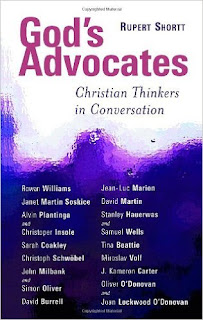
This book has been around for over a decade. It deserves a wider reading than (at least from my observations) it appears to have had. It consists of 'conversations' (but think seminar-room conversations rather than fireside chats!) between the editor, Rupert Shortt and 18 leading Christian thinkers from largely English-speaking contexts. All are academics or scholars: "established names and newer voices - in and on the fringes of the Anglophone world" (ix). Whilst acknowledging the largely Western (both theological and cultural) provenance of his conversation partners, Shortt points out that they represent a certain diversity (and there is certainly theological, ethnic, gender, and generational-diversity among his chosen theologians). Yet he also points to a certain consensus among them: "if my collaborators have a premise in common, it is that theology has recovered its nerve notably in recent years, especially in North America and Britain, and this confidence springs from renewed esteem for Christianity's core resources rather than a thirst for simplistic certainties" (ix). They are, in other words, united by a certain kind of ressourcement - in defiance of both secularism's and modern theology's ambivalence towards, if not rejection of, ancient wisdom. Yet all are equally oriented to the contemporary challenges of faith: issues of gender, race, medical ethics, sexuality, pacificism, linguistics, epistemology, Christian-Muslim relations, and many others are the fields where the ideas of classical Christianity are brought into play.

So who are Shortt's conversation partners? The full list is as follows: Rowan Williams, Janet Martin Soskice, Alvin Plantinga, Christopher Insole, Sarah Coakley, Christoph Schwobel, John Milbank, Simon Oliver, David Burrell, Jean-Luc Marion, David Martin, Stanley Hauerwas, Samuel Wells, Tina Beattie, Miroslav Volf, J. Kameron Carter, Oliver O'Donovan and Joan Lockwood O'Donovan. The conversations are presented in 14 chapters: ten are one-on-one conversations; four have the conversationalists in pairs. My own engagement varied across the chapters - some were discussing issues beyond my immediate interests whilst others were engaged with authors whose work I try to follow as closely as I can. Yet even in the case of the theologians whose work I follow, the conversational style opens up new insights into their thoughts and, perhaps more interestingly, their motivations (often drawn out quite intentionally and cleverly by Shortt).

So whilst commending the whole book as well worth reading, I will focus in this summary on the four conversations that most engaged me.

The conversation with Rowan Williams is, unsurprisingly, very wide ranging. It's a reminder, too, of how pivotal Williams himself has been in the ressourcement highlighted in this book. In this particular chapter, Shortt presses Williams on some basic objections to Christian faith, as well as the evolution of his own thought. They also discuss the overall coherence of Christian ideas. Williams finds this coherence in something of the shared orientation to the 'dislocation' generated by Jesus' death and resurrection. This is Christocentric theology whose very specific centre is a very particular puzzle. Williams is worth quoting on this point at length:

As for the coherence of the ideas of Christianity, everything evolves like the oak from the acorn out of that sense of dislocation that comes around the death and resurrection of Jesus. If Jesus is the one who now and for ever decides, determines, who is in the company of God, who is in the favour of God, who belongs to the people of God, then the authority, the inner solidity of who Jesus is, has to be connected with the very purpose of God, what God is about. Jesus acts as if he has the right to determine who belongs to the people of God. And he does that in welcome, in forgiveness and judgement all the other things that the Gospels spell out. And therefore, if you take him seriously, you have at some point to make the connection with, as I say, what God is about, what are the purposes of God, the desires of God. And distinctively Christian theology beings to take shape when those two things are brought together: the actions and the words and the sufferings of this particular human being, and the vision of a God whose purpose is unrestricted fellowship with the human beings that he's made (p.3).
Shortt and Williams also briefly exchange some reflections on the significance to English-language theology of The Myth of God Incarnate, the publication of which in 1977 is highlighted by Williams as the turning point of  Anglophone theology away from the liberal Protestantism which had prevailed in (at least British) academic circles for several decades. If this is where "rational revisionism" (p.16) was leading then it wasn't leading to very much. Referring to conversations with colleagues in the 1980s, he writes: "We shared a sense that we needed to get ourselves out of this rather narrow and oddly cosy liberal environment into a slightly intellectually more rigorous, spiritually more challenging - and even alarming - world. So, yes, there is a move away from what I think of as that rather pale liberal Protestant consensus." (p.17).

One of Williams' contemporaries at Cambridge at that time was Sarah Coakley. Coakley reports, however, that her own frustrations with 1970s/80s theology were somewhat different than those of Williams. For her, the theology of that period wasn't 'liberal' enough, and this led to a focus on Ernst Troeltsch in her early research. Yet her engagement with Troeltsch yielded a tension-filled outcome. She found that Troeltsch's historicist revisionist Christology led nowhere: "nothing much was left" (p.69). But there was another strand to Troeltsch' theology which she found more productive: it was his emphasis on Christ mysticism (which, on her reading, Troeltsch never reconciled to his doctrinally revisionist Christology). This allowed her "to glimpse that our approach to 'Christ' really can't be restricted by this sort of historical positivism: it must be that 'Christ' is available in other ways" (p.71). Ultimately, this led her to approach to theology "starting on my knees". This has results, as readers of her subsequent work will know, in a striking integration of systematic theology and prayer. Her reflections in this interview on her first moves in this direction are crystallised in this comment:

I had therefore to rediscover a vibrant and distinct sense of the Spirit, starting on my knees, before I could return to those lost strands of Christology and the Trinity that I seemed to have utterly dismantled in my Troeltschian 'liberal' quest. First, one has to go through this passage of handing over the reins of control to the Spirit; only then does one begin to see that the theologian who tries to speak of God - stammeringly - is always already engaged in a divine process that is going on all the time (p.71).
This 'handing over the reins' has deeply influenced her approach to systematic theology, a discipline which she argues - against convention - is consistent with her feminist commitments. For Coakley, systematics is  legitimate "attempt to enunciate a coherent vision", but with this proviso: "as long as systematics is undergirded by the disciplined 'practice' of non-mastery, such that theology itself is always in via, always undergoing its own apophatic displacement" (p.76f). Coakley has, of course, gone on to produce a systematic theology oriented to issues of gender, sexuality and desire. In doing so she has engaged, through her extensive appeal to patristic theologians, in one of the more interesting exercises in ressourcement in contemporary theology.


Another of Shortt's conversation partners who brings feminism into critically constructive dialogue with classical theology is Tina Beattie. Again, it is a wide-ranging and nuanced conversation which Shortt records. To my mind the most interesting case of ressourcement to which Beattie points is around the issue of sin. She both stresses the conventional - and some not so conventional - feminist critiques of classical accounts of sin. She appears dissatisfied with the dismissal of the idea of sin by some feminists as either an anachronistic or androcentric concept. At the same time, she draws on the feminist insight that "Christian ideas of sin are heavily invested with an unexamined fear of female sexuality" (p. 200). She clearly believes that the topic of sin needs deeper reflection than either the tradition or the feminist critique has offered. "Feminists", she writes, "need to take seriously the question of sin as a mysterious but profoundly personal experience of alienation and distorted desire which does seem to be part of the human condition, and this can't simply be attributed to the effects of patriarchy" (p.200).  After a reference to Freud, she continues: "Whether you call it original sin or the Oedipus complex, there's wisdom about human nature in these terms, and it needs a deeper theological response than criticising unjust social structures" (p.201). This is not a retreat from the feminist task, but a call to enter it more deeply, a call which must be accompanied by patience:

[I]t's premature to expect feminist theology come up with adequate solutions to these vast issues that it opens up. After all it took the early Church over three centuries and much political wrangling to get around to the Council of Nicaea. We might have to wait a few centuries yet before we have a Council of Lesbos that gives doctrinal recognition to women's theological insights (p.201).
If feminist theology will strike some as an unexpected location of theological ressourcement,  black theology is likely to be even more unexpected. Yet, Shorrt's conversation with J Kameron Carterprofessor of Systematic Theology and Black Church Studies at Duke University, offers a very fertile discussion between black theology and Christian orthodoxy. Carter's claim that the "category of culture must be baptised...before [theology] makes use of it" (p. 243) captures much of his approach - and of his critique of liberal theology. On his reading, this is what liberal theology, and not least in its 'black' versions, failed to do. 'Culture' was regarded as self-evidently theologically significant. What is interesting in Carter's critique, however, is that he sees this move in liberal theology as the manifestation, not of novelty, but of a deep rooted tendency in historic Christian theology. The prioritisation of culture is a choice for one side of the binary, the ancient roots of which lie in differences Alexandrian and Antiochene Christologies. Today we describe the binary as one of 'theology from below' or 'theology from above'. Carter believes that this binary must be subverted. To do so he appeals to a theology as ancient as the binary itself: Chalcedon!   It is the classic - Chalcedonian - conviction that "in Christ there is no break between his humanity and divinity" which gives Carter critical leverage against liberal theology - and indeed, against both 'white theology' and its binary opposite, 'black theology'. He sets out this argument as follows:

[F]ormulating a 'black Christology'..., at least as typically conceived, is problematic. Put succinctly, it risks replicating the very procedures of 'white theology' namely, of operating out of a notion of 'pure nature' as culturally inflected through the notion of whiteness. ... White theology has too often functioned from a  position of pure nature, a nature that is so pure that white theology need not name itself as 'white', for it is 'natural', indicative of the 'true state and proper order of things.... [T]o formulate a 'black Christology' or  a 'black systematics' as typically conceived is to risk replicating this procedure, where 'black' comes to function in an essentialised or 'pure' manner (p. 242).

There are many steps in this argument, and the above quotation barely skims the surface (the argument is developed at length in his Race: A Theological Account (OUP, 2008)). It is theologically deeper than  a conventional critique of essentialism. There are two especially intriguing dimensions to it.  Firstly, he draws on none other than the twentieth-century Catholic theologian Henri de Lubac (quite something for a young black American Baptist theologian to do!) to make his point. He appeals to de Lubac's insistence that nature cannot be abstracted from grace. When theology appeals to culture (as something 'natural') it indulges in precisely such an abstraction. The second is the strong historical connection he makes between the tendency of classic Christianity to de-Judaising of Jesus and Christian theology's frequent blindness to race.

Carter's attempt to bring black theology and orthodoxy into conversation takes some of its force from his reference to the nineteenth-century black political activist, Maria Stewart (1803-1979). Carter points out that Stewart's activism was fuelled in part by "important scriptural-exegetical work" as well as ideas "deriving from such figures as Julian of Norwich" (p.239). He claims that this very early engagement with classic Christian traditions and theologies has been "largely discarded in the modern evolution of racial discourse" (p.239). His own approach to is to retrieve and develop that earlier tradition.

Shorrt's conversation with Carter concludes with Carter reflecting on his involvement at Mount Level Baptist Church in Durham, N.C., where he is an associate minister. One sentence alone of this section is worth quoting, and it is an important reminder of the real benchmark of theology - perhaps especially if it is an instance of ressourcement - whilst also being a reminder of why theology matters in the first place: "Theological discourse, no matter it orientation, will always have its deepest witness in the lives it is able to produce" (p.246).

This is a good book which greatly rewards a reading of even some of its chapters. To an extent it is a 'report' on some of the key theologians writing in English today. It provides fresh insights into the intellectual vibrancy of classic Christian theology.  It also offers some interesting windows into the personal and intellectual biographies of thinkers who are otherwise known only through their formal academic writing. The book would be useful to theological students and, indeed, to anyone with some background in theology who would like to get an idea of who's thinking what in the contemporary Anglophone theological world. I suspect that few readers would get through the book without having some of the prevailing caricatures about English-language theology and theologians unsettled.

* * * * *

(This series of 'books worth reading' engages an eclectic selection of books: some directly related to my teaching, some to the UCA, and some of more general theological interest. They are not offered as technical book reviews, but as summaries which highlight why I think they might be useful resources, good conversation starters, or volumes that make helpful contributions to scholarly debate.)


Sunday, July 5, 2015

Books Worth Reading (3): David Ford's The Future of Christian Theology

David F. Ford, The Future of Christian Theology (Chichester: Wiley-Blackwell, 2011)


This book is part of the Blackwell Manifesto series. In fact, if you go to this video (and below), you can watch Ford explain how, in the process of writing it, he was in dialogue with the authors of the parallel manifestos for Jewish and Islamic theology. Such dialogue is typical of David Ford's writings and  this Manifesto reflects these and other conversations. There are theological engagements with the state of the 'secular'; he studies how Christian theology can be 'blessed' by other faiths; he explores the multiple communities in which theology is performed; he writes of the need for theological apprenticeship; he addresses institutional and funding issues on which the future of theology will depend. Although written from the heart of British academic theology (Ford is Regius Professor of Divinity at Cambridge), the book reflects Ford's interest in global theology and the diverse communities from which theology emerges and which it serves. For all these reasons the book is worth reading. Nevertheless, I will specify two particular aspects of his argument which make this book an especially worthwhile read.


The first relates to the openness of Christian theology and the grounds of that openness. I am frequently drawn into conversations about the systematic nature of systematic theology and the criticism that precisely by being systematic the discipline over-organises the material of Christian theology. Just recently I was in a meeting where systematic theology was summarily dismissed as 'too rigid'. This is not an unfair criticism of some strands of systematic theology, but not, however, of its best exponents. (See my earlier post discussing Sarah Coakley's reponse to such criticisms). Ford is not preoccupied with this criticism, nor is the book an apology for systematic theology. Nevertheless he has some useful ways of exploring the openness of the Christian theological task. With echoes of von Balthasar, and before him, Hegel,  Ford uses a typology of 'epic', 'lyric' and 'drama' to distinguish different theological styles. The "epic mindset", he writes, "likes clarity completeness, and objectivity, systems, overviews and comprehensive structures" (p.25). Lyric theology concerns itself with "inwardness, self-expression and the present moment" and embraces "messiness and loose ends" (p.25). As such, lyric theology can be a corrective to epic theology. Yet, the danger with the lyric style is that it can "give up on a coherent plot, an overarching meaning" (p.26). Drama, on the other hand, "is able to embrace the objective and the subjective, to maintain a sense of plot and purpose without supressing individuality [or] diversity" (p.26). It can "have epic detachment and lyric intensity, and enable a sense of coherence without assuming one overview" (p.26).

Ford prefers the dramatic because he believes that it is characteristic of the biblical testimony itself, and for that reason has a particular claim on the work of theological reflection. The Bible, he writes,
testifies to a real drama of love and freedom, and the most serious matters are at stake in the interactions of God, humanity, and creation. ... Human freedom is fulfilled in involvement with God and God's purposes, and this means constant discernment of vocation and responsibility within an unfolding drama whose central act is the life, death and resurrection of Jesus Christ (p.27). 
David Ford
Of course, the appeal to the dramatic is not uncommon in contemporary theology. What makes Ford's approach especially interesting is the way he deepens the biblical foundation for it. Theology will maintain this dramatic posture if it attends to the different 'theological moods' present in the bible and reflects them in its constructive work. Too much theology, he says, is in the imperative and indicative moods. Christian theology must also develop its discourses in the subjunctive and interrogative moods. He refers to the conventional "deadening lack of recognition of the complex interplay of moods across a range of biblical books" (p.71) and argues that a greater recognition of those moods and their 'ecology' will generate theological styles reflective of the biblical witness itself.

The second aspect of his argument which makes this book worth reading is his discussion of the 'elements' of wise and creative theology. Ford suggests that such theology is characterised by these four elements: retrieving the past; engaging with God, community and world; thinking; and communication. These are spelled out in the book, but their suggestiveness should be immediately apparent. Perhaps the most striking feature of this discussion is Ford's emphasis on 'communication'. Here too he finds precedent and mandate in the Bible itself. He suggests that, historically, theological fruitfulness is linked to theological creativity. "For theology to do what the Bible did, as well as to interpret what the Bible said, means that it should pursue creativity in expression and performance in many modes" (p. 203).

To my mind, this approach to 'wise and creative' theology is a more artful and interesting approach to theological judgement than the much invoked, but somewhat flatfooted, quadrilateral (Wesleyan or otherwise) of scripture, tradition, reason and experience. I have used this quadrilateral as a very basic resource for introducing new theological students to the sources of theology. As an introductory resource it is useful. Nevertheless, I have become increasingly uncomfortable with way it often gets taken up. It is treated as an unstructured quartet which any of the other three can displace the Bible from its primary place rather than operate as hermeneutical aids in the reading of the Bible. Secondly, it too easily creates an impression that once you arrange these sources in a particular way you have a theological method which guarantees a 'correct' answer. It thereby tempts the theologian to the wrong sort of confidence. In contrast, Ford's 'wise and creative' theology keeps theologians on their toes, bringing them into a more dynamic, unpredictable, and humble approach to their task.

I think this book would be especially helpful to those in the middle of a theological degree and to those theological graduates who want to acquaint themselves with some important current trends in the task of theology. For both groups it would be well worth reading.


Sunday, February 2, 2014

Systematic theology and its strangeness (2)

"Systematic theology has fallen on evil days". 
"There are few phenomena in the theological world which are more striking indeed than the impatience which is exhibited on every hand with the effort to define truth and state with precision the doctrinal presuppositions and contents of Christianity."

Despite the echoes in these remarks of sentiments possibly to be heard from contemporary systematic theologians lamenting all the challenges to their discipline in these postmodern days, these comments are actually over a century old. In fact, they were written in 1897. The first were penned by Edinburgh's Professor James Orr in his Introduction to Benjamin Warfield's The Right of Systematic Theology. The second are from the main body of Warfield's text itself.

It is interesting to read Warfield's summary of the sources of this 'impatience': claims that Christianity is about life, not thought; that it proclaims acts of God, not dogmas; and the concern that doctrine is a (Greek) way of truth-telling alien to the witness of the biblical narratives. Again, it's all very familiar. Less familiar, perhaps, is Warfield's confidence in aspiring towards a "pretty complete systematic theology" and justifying it with the claim that from the beginning Christianity has "ever come to men (sic) as rational religion, making its appeal to the intellect".  It's not that you don't have to scratch too far below the surface to discover the rhetoric of modernity in Warfield's protest, you don't have to scratch at all. 

It is interesting to ponder the history of the discipline in the intervening century, not least the development of the discipline, especially in English-speaking circles in the last two to three decades in particular. The 'impatience' with it has not subsided, but, as a discipline, systematic theology is lively, energetic and developing on multiple fronts. And it needs to be said that it has developed in directions that Warfield himself is unlikely to have approved of. The quest for 'completion' has not been abandoned, but it's surrounded by caution. Claims for the rationality, or perhaps the 'reasonableness', of Christianity are still made, but without the clear definitions of rationality which Warfield assumed.

Both of these developments have been very much shaped by the strange institutional location of the discipline, i.e., at the boundary of the church and the academy. Systematic theology faces some particular challenges in straddling this boundary (challenges which may or may not be shared with other theological disciplines). Some of these challenges were explored by the Catholic scholar, Nicholas Healy, in a 2009 essay, "What is Systematic Theology". Healy argues that systematic theology "must necessarily be a bit of an outsider in both the church and the university". When it shifts too much to the academic side of the boundary, it becomes an outsider to the church because its enquiring and constructive tendencies bring it into critical relationships with the church's ordinary and official theologies. When it shifts its balance back to the church side of the boundary, it becomes an outsider to the academy because its insistence on the transcendent nature of it's subject matter, i.e., God. (Healy argues all this at much greater length and helpfully differentiates between ordinary, official and professional forms of systematic theology.)

Yet claiming a transcendent subject matter is only the beginning of the problem. To say that the discipline's transcendent subject matter is God is not a stand-alone claim. Christianity fleshes out this claim by articulating a comprehensive vision of God and God's relation to the world. Here the claim for comprehensiveness and totality bumps into the claim of the postmodern academics that all such total claims (or meta-narratives) presuppose a totality of vision which no person or community can claim. And  to the extent that such a totality of vision is a truth claim (which it inevitably is), it invites the related criticism that truth claims are simply products of the time, place and circumstance of those who make them. According to that criticism, the 'effort to define truth' is not only misplaced, it is pretentious.

One important response from within systematic theology to these sorts of criticisms, has been articulated very powerfully by the English theologian, Sarah Coakley. She unapologetically pursues what she has coined a théologie totale. Her ideas around this theme have been emerging over recent years, and have now begun to take more formal shape in the recently published first volume of her own systematic theology, God, Sexuality and the Self. She refuses to abandon the making of truth claims, but does so in ways that "reason is stretched and changed beyond its normal, secular reach". This stretching occurs not least because she brings prayer, contemplation and desire into the theological task. 

Upending much of the postmodern concern about total visions, she argues that the pursuit of a total vision of God and God's ways in the world, far from being a strategy for control, is actually a practice of constant critique and renewal. In her own words théologie totale is
an attempt to do justice to every level, and type, of religious apprehension and its appropriate mode of expression. Thus it is devoted precisely to the excavation and evaluation of what has previously been neglected: to theological fieldwork in a variety of illuminating social and political contexts....; to religious cultural products of the arts and the imagination; to neglected or sidelined texts in the tradition; and to examination of the differences made to theology by such factors as gender, class or race. 
Her argument moves towards a proposal for an 'unsystematic systematics':
In short théologie totale makes the bold claim that the more systematic one's intentions, the more necessary the exploration of such dark and neglected corners; and that, precisely as a theology in via, théologie totale continually risks destabilization and redirection. In an important sense, then, this form of systematic theology must always also remain, in principle, unsystematic. 
All this is part of an attempt to "recapture the contemporary imagination for Christ, [and] to reinvite reflection on the perennial mysteries of the gospel". (Some of the ideas around gender and sexuality which emerge in this first volume can be sampled here. And, it will be interesting to see what role she gives to Christ and the biblical witness to him in future volumes of her (unsystematic) systematics.)

I suspect that neither Benjamin Warfield or James Orr would be entirely enamored of an unsystematic systematics. They may even find these days no less 'evil' than those of 1897. Perhaps they were just a little too impatient with the impatience directed at their discipline. That others have constructively engaged that impatience over the last century has refined and renewed systematic theology - albeit in ways which have not necessarily reduced its strangeness. Again to quote Healy, straddling the church and the academy, systematic theology is "a constructively unsettling element in both".


References: 
Benjamin B. Warfield, The Right of Systematic Theology (Edinburgh: T&T Clark, 1897).

Nicholas Healy, "What is Systematic Theology", International Journal of Systematic Theology 11 (2009), pp. 24-39.

Sarah Coakley, God, Sexuality and the Self: An Essay on the Trinity (Cambridge: CUP, 2013).


Tuesday, January 28, 2014

Systematic theology and its strangeness (1)

As indicated in my first post, this blog has been motivated in part by the mandate in my position description to foster an understanding of ‘systematic theology’ in the wider context of the church in which I serve. My hope is that it might become - among other things - a resource for sparking some reflection and perhaps even conversation about systematic theology. So, this will be the first of two related posts about the discipline of systematic theology. Both will also take the up the theme of strangeness included in the blog’s title. Then, in the next couple of weeks, there will be posts (again in line with the blog’s purpose and name) about the Uniting Church in Australia and its strangeness, and then about the strangeness of Jesus and the church's message about him.

* * * * * * * * 

Once upon a time, systematic theology did not exist. Of course, Christian thinkers who reflected and wrote about the faith systematically emerged very early in the Christian story. De Principiis by Origen of Alexandria (c184-c253) is usually taken to be the first instance of such writing. From then on, a tradition of systematic thinkers has been a prominent feature of the church. But a specific discipline which calls itself ‘systematic theology’ is a relatively new development in the church’s history. 

We are so used to the divisions of theological disciplines into, say, biblical studies, church history, pastoral theology, and systematic theology etc., that we can take them for granted and think that they always existed. They didn’t. That they do now owes much to the impact of the structure of theological study proposed by Friedrich Schleiermacher in his 1811 book, Brief Outline of the Study of Theology. Nevertheless, in dividing up the study of theology for academic purposes, ‘systematic theology’ is not, in fact, one of Schleiermacher's formal categories. But under the heading of  'dogmatics', we do see him making the point that dogmatics is sometimes referred to as ‘systematic theology’. So, that would suggest the term ‘systematic theology’ has had some currency for at least two centuries and a bit. A quick check of my own institution’s library indicates that the first volume to include ‘systematic theology’ in its title was published in 1865. Moving the discussion forward to recent decades, the late Colin Gunton once noted that it was only in the 1980s that the University of London changed the names of its courses in Christian Doctrine to those of Systematic Theology.


Is this just a name change? Gunton himself addresses this question in quite some detail. But for the purposes of this blog, let me suggest just two tendencies which are more likely to be explicitly associated with ‘systematic theology’ than they are with ‘dogmatics’ or ‘doctrine’. Rightly or wrongly, 'dogmatics' and 'doctrine' often imply static lists of what the church believes. So understood, to engage with doctrine is to learn and master such lists. To engage in systematic theology, however, entails a greater intentionality to explore, not just a list of discrete topics, but how the different doctrinal topics relate to each other systematically. For instance, a belief in the incarnation, implies something about salvation. A belief in salvation implies something about sin; a belief in sin implies something about creation and its goodness. And so on. So, that’s the first tendency more likely to be associated with systematic theology: it attends to the inter-relatedness  or ‘coherence’ of the faith. It inquires into the ways the Christian faith ‘hangs together’. 

The second tendency is what could be called the 'constructive' impulse of the discipline. If doctrine and/or dogmatics implies merely retrieval or repetition of past teachings, systematic theology goes beyond them and ventures to construct an account of the faith which engages with, and responds to, alternative world views. It does so in the conviction that the broad themes of Christian doctrine are themselves dynamic sources of wisdom generative of fresh articulations of the Christian faith. A good recent example of this would be the twentieth-century developments in the doctrine of the Trinity. These developments were provoked in the midst of Christendom’s collapse by the need for the church again to clarify on multiple intellectual and cultural fronts what it meant by ‘God’. A doctrine long-neglected became the topic of widespread constructive theological activity. 

So, ‘coherence’ and ‘construction’: two important features of systematic theology. To some extent, however, these themes are simply two sides of the one coin. A building whose internal structures don’t cohere with each other is a structure unlikely to survive much stress. This is no less true for intellectual and spiritual constructions. But why should this be a source of strangeness? 

It is strange not least because just as the gospel of Jesus Christ has an impulse towards coherence, it also has an impulse to resist it. To the extent that at least each of the gospels, if not every New Testament document, bears witness to Jesus by presenting him in the context of Israel’s hope for the redemption of itself and all creation, Christian faith confesses a drama which is about the ways of the one God with and for the one world. There is a story to be told. Yet, as again the gospels demonstrate, there is no one way of telling it. The drama of Jesus Christ is just that, a drama. As a drama it is to some extent open-ended and its proclamation is properly susceptible to diverse tellings. No less a systematic thinker than the twentieth-century's Karl Barth (who was famously wary of being overly-systematic) once put it like this: “The good news of Jesus Christ is not a dead commodity handed over to us so that we can ‘have’ it…. The gospel must ever again be explored and sought and inquired into”. 

Some of the strangeness of systematic theology emerges, therefore, as it lives between these two apparently competing impulses. To suggest one way of conceptualising this, I borrow a comment about the book of Isaiah from the biblical scholar, Walter Brueggemann. Noting that Isaiah's diverse authors, diverse contexts, and correspondingly diverse themes, Brueggemann nevertheless proposes that it is held together as a unified book by a “suggestive coherence”. I think that’s a helpful way of thinking about the coherence of systematic theology. The coherence to which it aspires is grounded in the gospel it seeks to articulate. But it knows that as an intellectual construction, it is only suggestive. That is not a reason to surrender the quest for coherence, nor even a reason to hesitate in making suggestions. Rather, it is a reminder of the contingency of all systematic theology, and its proper openness to correction and revision.

In the next blog I'll reflect a little on the strangeness of the discipline which is highlighted by its unusual institutional location at the interface of the academy and the church, and it's consequent exposure to postmodern criticism.

References:

Friedrich Schleiermacher, Brief Outline for the Study of Theology as a Field of Study 3rd edn (Lousiville: WJKP, 2011), pp. 42, 73.

Colin Gunton, "A Rose by Any Other Name? From 'Christian Doctrine' to 'Systematic Theology', International Journal of Systematic Theology 1 (1999), pp. 1-23.

Karl Barth, Learning Jesus Christ Through the Heidelberg Catechism (Grand Rapids: Eerdmans, 1964), p.19.

Walter Brueggemann, An Introduction to the Old Testament: The Canon and Christian Imagination (Louisville: WJKP, 2003), p.160

Monday, December 9, 2013

Starting a blog


The PD for my position at the CTM includes this in my tasks: “Foster an understanding of systematic theology in the life of the Synod, promoting new initiatives as appropriate.” The measurable outcome for this task is: “Systematic theology has a high profile in the life of the church”. I’m not quite sure what criteria will be used to measure that outcome.  Nor am I entirely sure, at this stage, just how I’ll go about addressing the task. I haven’t been back in this Synod long enough to have any real idea of just how systematic theology is already understood and what contributions I might make to ‘fostering’ that understanding.

Anyway, this seems a good reason to start a blog, and to use it to foster some thinking, provide some resources, and perhaps even spark some discussion about systematic theology (and theology more generally).

And the name? It’s based on Acts 17:20 and the Athenian philosophers’ response to Paul’s strange message about Jesus Christ: “We have heard you say some strange things and we want to know what you mean.” I think this is an appropriate framework for this blog.

Christianity is strange. The proclamation about Jesus Christ was strange in the ancient world. Emerging now from the domesticated pieties of Christendom, Jesus Christ can again address the church and the world with the theological, ethical and spiritual novelty of his way. (I've just recently explored some of these ideas in this short reflection on Christmas.)

Systematic theology is strange. Of all the academic theological disciplines it is arguably the one that sits most uneasily to contemporary academic culture, and it is often treated with suspicion within the church precisely because it is, well, systematic. It is seen to bring too much intellectual organisation to the life of faith. In my view, the more creative exponents of the discipline show how being systematic and being open belong, in their own strange way, to each other.

The Uniting Church is strange. In the very act of union it was called to take a step out of Christendom and its denominationalism. Just how big a step we actually took remains an open question. The Basis of Union presents an account of Jesus which precisely in its orthodoxy subverts the conventional liberal/conservative spectrum we inherited from our mainstream Protestant heritage. I’m not sure that we’ve yet come to terms with that particular Christology. So, in their strangeness, the UCA and its theology are hard to classify.  

These different sources of strangeness will be some of the driving forces of this blog.