Rupert Shortt,
God's Advocates: Christian Thinkers in Conversation (London: DLT, 2005).
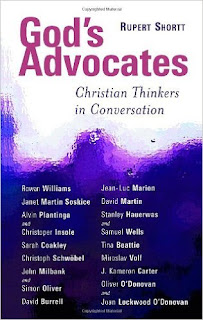
This book has been around for over a decade. It deserves a wider reading than (at least from my observations) it appears to have had. It consists of 'conversations' (but think seminar-room conversations rather than fireside chats!) between the editor, Rupert Shortt and 18 leading Christian thinkers from largely English-speaking contexts. All are academics or scholars: "established names and newer voices - in and on the fringes of the Anglophone world" (ix). Whilst acknowledging the largely Western (both theological and cultural) provenance of his conversation partners, Shortt points out that they represent a certain diversity (and there is certainly theological, ethnic, gender, and generational-diversity among his chosen theologians). Yet he also points to a certain consensus among them: "if my collaborators have a premise in common, it is that theology has recovered its nerve notably in recent years, especially in North America and Britain, and this confidence springs from renewed esteem for Christianity's core resources rather than a thirst for simplistic certainties" (ix). They are, in other words, united by a certain kind of
ressourcement - in defiance of both secularism's and modern theology's ambivalence towards, if not rejection of, ancient wisdom. Yet all are equally oriented to the contemporary challenges of faith: issues of gender, race, medical ethics, sexuality, pacificism, linguistics, epistemology, Christian-Muslim relations, and many others are the fields where the ideas of classical Christianity are brought into play.
So who are Shortt's conversation partners? The full list is as follows: Rowan Williams, Janet Martin Soskice, Alvin Plantinga, Christopher Insole, Sarah Coakley, Christoph Schwobel, John Milbank, Simon Oliver, David Burrell, Jean-Luc Marion, David Martin, Stanley Hauerwas, Samuel Wells, Tina Beattie, Miroslav Volf, J. Kameron Carter, Oliver O'Donovan and Joan Lockwood O'Donovan. The conversations are presented in 14 chapters: ten are one-on-one conversations; four have the conversationalists in pairs. My own engagement varied across the chapters - some were discussing issues beyond my immediate interests whilst others were engaged with authors whose work I try to follow as closely as I can. Yet even in the case of the theologians whose work I follow, the conversational style opens up new insights into their thoughts and, perhaps more interestingly, their motivations (often drawn out quite intentionally and cleverly by Shortt).
So whilst commending the whole book as well worth reading, I will focus in this summary on the four conversations that most engaged me.
The conversation with
Rowan Williams is, unsurprisingly, very wide ranging. It's a reminder, too, of how pivotal Williams himself has been in the
ressourcement highlighted in this book. In this particular chapter, Shortt presses Williams on some basic objections to Christian faith, as well as the evolution of his own thought. They also discuss the overall coherence of Christian ideas. Williams finds this coherence in something of the shared orientation to the 'dislocation' generated by Jesus' death and resurrection. This is Christocentric theology whose very specific centre is a very particular puzzle. Williams is worth quoting on this point at length:
 As for the coherence of the ideas of Christianity, everything evolves like the oak from the acorn out of that sense of dislocation that comes around the death and resurrection of Jesus. If Jesus is the one who now and for ever decides, determines, who is in the company of God, who is in the favour of God, who belongs to the people of God, then the authority, the inner solidity of who Jesus is, has to be connected with the very purpose of God, what God is about. Jesus acts as if he has the right to determine who belongs to the people of God. And he does that in welcome, in forgiveness and judgement all the other things that the Gospels spell out. And therefore, if you take him seriously, you have at some point to make the connection with, as I say, what God is about, what are the purposes of God, the desires of God. And distinctively Christian theology beings to take shape when those two things are brought together: the actions and the words and the sufferings of this particular human being, and the vision of a God whose purpose is unrestricted fellowship with the human beings that he's made (p.3).
Shortt and Williams also briefly exchange some reflections on the significance to English-language theology
of The Myth of God Incarnate, the publication of which in 1977 is highlighted by Williams as the turning point of Anglophone theology away from the liberal Protestantism which had prevailed in (at least British) academic circles for several decades. If this is where "rational revisionism" (p.16) was leading then it wasn't leading to very much. Referring to conversations with colleagues in the 1980s, he writes: "We shared a sense that we needed to get ourselves out of this rather narrow and oddly cosy liberal environment into a slightly intellectually more rigorous, spiritually more challenging - and even alarming - world. So, yes, there is a move away from what I think of as that rather pale liberal Protestant consensus." (p.17).

One of Williams' contemporaries at Cambridge at that time was
Sarah Coakley. Coakley reports, however, that her own frustrations with 1970s/80s theology were somewhat different than those of Williams. For her, the theology of that period wasn't 'liberal' enough, and this led to a focus on Ernst Troeltsch in her early research. Yet her engagement with Troeltsch yielded a tension-filled outcome. She found that Troeltsch's historicist revisionist Christology led nowhere: "nothing much was left" (p.69). But there was another strand to Troeltsch' theology which she found more productive: it was his emphasis on Christ mysticism (which, on her reading, Troeltsch never reconciled to his doctrinally revisionist Christology). This allowed her "to glimpse that our approach to 'Christ' really can't be restricted by this sort of historical positivism: it must be that 'Christ' is available in other ways" (p.71). Ultimately, this led her to approach to theology "starting on my knees". This has results, as readers of her subsequent work will know, in a striking integration of systematic theology and prayer. Her reflections in this interview on her first moves in this direction are crystallised in this comment:
I had therefore to rediscover a vibrant and distinct sense of the Spirit, starting on my knees, before I could return to those lost strands of Christology and the Trinity that I seemed to have utterly dismantled in my Troeltschian 'liberal' quest. First, one has to go through this passage of handing over the reins of control to the Spirit; only then does one begin to see that the theologian who tries to speak of God - stammeringly - is always already engaged in a divine process that is going on all the time (p.71).
This 'handing over the reins' has deeply influenced her approach to systematic theology, a discipline which she argues - against convention - is consistent with her feminist commitments. For Coakley, systematics is legitimate "attempt to enunciate a coherent vision", but with this proviso: "as long as systematics is undergirded by the disciplined 'practice' of non-mastery, such that theology itself is always
in via, always undergoing its own apophatic displacement" (p.76f). Coakley has, of course, gone on to produce a
systematic theology oriented to issues of gender, sexuality and desire. In doing so she has engaged, through her extensive appeal to patristic theologians, in one of the more interesting exercises in
ressourcement in contemporary theology.

Another of Shortt's conversation partners who brings feminism into critically constructive dialogue with classical theology is
Tina Beattie. Again, it is a wide-ranging and nuanced conversation which Shortt records. To my mind the most interesting case of
ressourcement to which Beattie points is around the issue of sin. She both stresses the conventional - and some not so conventional - feminist critiques of classical accounts of sin. She appears dissatisfied with the dismissal of the idea of sin by some feminists as either an anachronistic or androcentric concept. At the same time, she draws on the feminist insight that "Christian ideas of sin are heavily invested with an unexamined fear of female sexuality" (p. 200). She clearly believes that the topic of sin needs deeper reflection than either the tradition or the feminist critique has offered. "Feminists", she writes, "need to take seriously the question of sin as a mysterious but profoundly personal experience of alienation and distorted desire which does seem to be part of the human condition, and this can't simply be attributed to the effects of patriarchy" (p.200). After a reference to Freud, she continues: "Whether you call it original sin or the Oedipus complex, there's wisdom about human nature in these terms, and it needs a deeper theological response than criticising unjust social structures" (p.201). This is not a retreat from the feminist task, but a call to enter it more deeply, a call which must be accompanied by patience:
[I]t's premature to expect feminist theology come up with adequate solutions to these vast issues that it opens up. After all it took the early Church over three centuries and much political wrangling to get around to the Council of Nicaea. We might have to wait a few centuries yet before we have a Council of Lesbos that gives doctrinal recognition to women's theological insights (p.201).

If feminist theology will strike some as an unexpected location of theological
ressourcement, black theology is likely to be even more unexpected. Yet, Shorrt's conversation with
J Kameron Carter, professor of Systematic Theology and Black Church Studies at Duke University, offers a very fertile discussion between black theology and Christian orthodoxy. Carter's claim that the "category of culture must be baptised...before [theology] makes use of it" (p. 243) captures much of his approach - and of his critique of liberal theology. On his reading, this is what liberal theology, and not least in its 'black' versions, failed to do. 'Culture' was regarded as self-evidently theologically significant. What is interesting in Carter's critique, however, is that he sees this move in liberal theology as the manifestation, not of novelty, but of a deep rooted tendency in historic Christian theology. The prioritisation of culture is a choice for one side of the binary, the ancient roots of which lie in differences Alexandrian and Antiochene Christologies. Today we describe the binary as one of 'theology from below' or 'theology from above'. Carter believes that this binary must be subverted. To do so he appeals to a theology as ancient as the binary itself: Chalcedon! It is the classic - Chalcedonian - conviction that "in Christ there is no break between his humanity and divinity" which gives Carter critical leverage against liberal theology - and indeed, against both 'white theology' and its binary opposite, 'black theology'. He sets out this argument as follows:
[F]ormulating a 'black Christology'..., at least as typically conceived, is problematic. Put succinctly, it risks replicating the very procedures of 'white theology' namely, of operating out of a notion of 'pure nature' as culturally inflected through the notion of whiteness. ... White theology has too often functioned from a position of pure nature, a nature that is so pure that white theology need not name itself as 'white', for it is 'natural', indicative of the 'true state and proper order of things.... [T]o formulate a 'black Christology' or a 'black systematics' as typically conceived is to risk replicating this procedure, where 'black' comes to function in an essentialised or 'pure' manner (p. 242).
There are many steps in this argument, and the above quotation barely skims the surface (the argument is developed at length in his
Race: A Theological Account (OUP, 2008)). It is theologically deeper than a conventional critique of essentialism. There are two especially intriguing dimensions to it. Firstly, he draws on none other than the twentieth-century Catholic theologian
Henri de Lubac (quite something for a young black American Baptist theologian to do!) to make his point. He appeals to de Lubac's insistence that nature cannot be abstracted from grace. When theology appeals to culture (as something 'natural') it indulges in precisely such an abstraction. The second is the strong historical connection he makes between the tendency of classic Christianity to de-Judaising of Jesus and Christian theology's frequent blindness to race.
Carter's attempt to bring black theology and orthodoxy into conversation takes some of its force from his reference to the nineteenth-century black political activist, Maria Stewart (1803-1979). Carter points out that Stewart's activism was fuelled in part by "important scriptural-exegetical work" as well as ideas "deriving from such figures as Julian of Norwich" (p.239). He claims that this very early engagement with classic Christian traditions and theologies has been "largely discarded in the modern evolution of racial discourse" (p.239). His own approach to is to retrieve and develop that earlier tradition.
Shorrt's conversation with Carter concludes with Carter reflecting on his involvement at Mount Level Baptist Church in Durham, N.C., where he is an associate minister. One sentence alone of this section is worth quoting, and it is an important reminder of the real benchmark of theology - perhaps especially if it is an instance of
ressourcement - whilst also being a reminder of why theology matters in the first place: "Theological discourse, no matter it orientation, will always have its deepest witness in the lives it is able to produce" (p.246).
This is a good book which greatly rewards a reading of even some of its chapters. To an extent it is a 'report' on some of the key theologians writing in English today. It provides fresh insights into the intellectual vibrancy of classic Christian theology. It also offers some interesting windows into the personal and intellectual biographies of thinkers who are otherwise known only through their formal academic writing. The book would be useful to theological students and, indeed, to anyone with some background in theology who would like to get an idea of who's thinking what in the contemporary Anglophone theological world. I suspect that few readers would get through the book without having some of the prevailing caricatures about English-language theology and theologians unsettled.
* * * * *
(This series of 'books worth reading' engages an eclectic selection of books: some directly related to my teaching, some to the UCA, and some of more general theological interest. They are not offered as technical book reviews, but as summaries which highlight why I think they might be useful resources, good conversation starters, or volumes that make helpful contributions to scholarly debate.)
 I spent Thursday and Friday of last week at Biola University, Los Angeles, attending the fifth annual LA Theology Conference. The theme was 'The Task of Dogmatics'. Here are a few observations.


